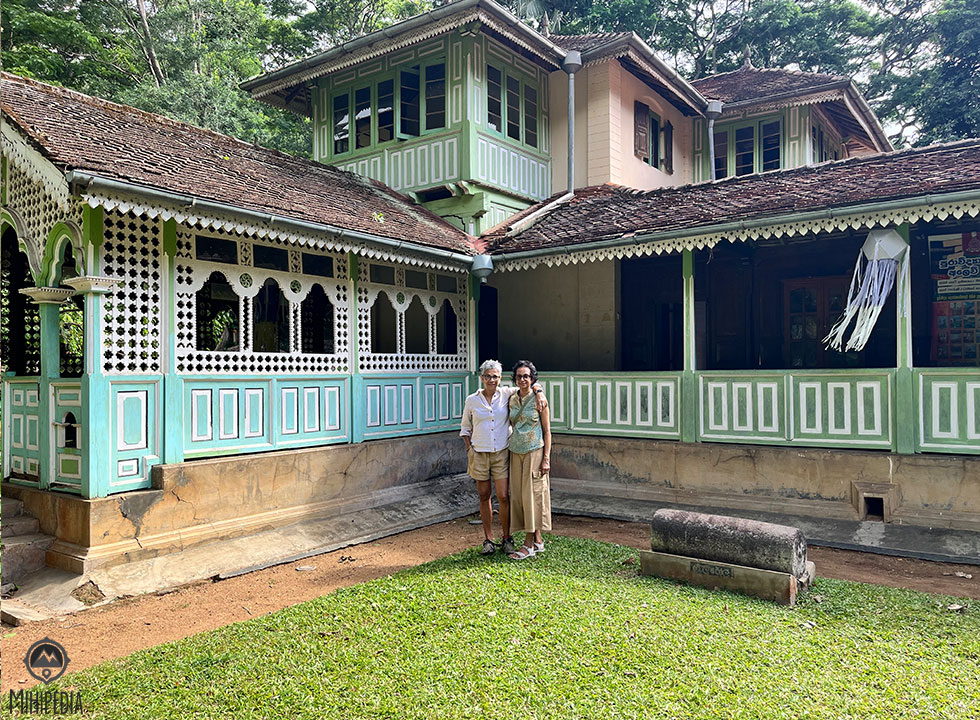
Some weekends are about ticking places off a list. Others are about stumbling into stories.
This was one of those weekends.
“Some weekends are about ticking places off a list. Others are about stumbling into stories.”
We left Colombo on Saturday morning, heading towards our first destination, the legendary Maduwanwela Walawwa, one of Sri Lanka’s most fascinating aristocratic residences.

As the roads narrowed and the scenery shifted from busy towns to paddy fields and sleepy villages, it felt as though we were travelling backwards through time.

Maduwanwela Walawwa is located between Embilipitiya and Rakwana, approximately 207 kilometres from Colombo. The walawwa dates back to the early 1700s and was expanded over generations by the powerful Maduwanwela family. At its peak, the estate was said to cover nearly 80,000 acres, while the mansion itself contained an astonishing 121 rooms and 21 inner courtyards. Today, only a fraction remains, but even in its reduced form, it is enough to leave us wandering through its corridors in quiet awe, guided by a very knowledgeable on-site man from the Archeological Department.
The story of the walawwa begins even earlier, rooted in folklore and omen. An ancestor of the Maduwanwela clan is said to have witnessed an extraordinary sight while hunting when he saw a hare chasing a jackal. Interpreting this reversal of nature as a sign of courage and victory, he declared the land a jaya bhumiya (blessed land) and chose it as the site for the family’s future home.


The original manor was built during the Dutch period in the early 1700s by Maduwanwela Maha Mohottala. Over successive generations, it expanded steadily, but it was Sir James Williyams Maduwanwela Maha Disawe, better known as Maduwanwela Maha Disawe who transformed it into the grand complex we see remnants of today. By 1905, the walawwa had grown into a sprawling estate of 121 rooms arranged around 21 inner courtyards (meda midula), protected by thick walls and designed to project both authority and prestige.
Born in 1844, he was appointed Dissava by the British colonial administration, making him one of the most influential local rulers of his time. Yet despite holding a title granted by the colonial government, he was widely regarded as a fiercely proud and quietly defiant figure. Across Sabaragamuwa, he became known as the “Black Prince of Sabaragamuwa” a landowner whose influence stretched across vast territories and whose estate was said to cover nearly 80,000 acres.
Yet behind the wealth, authority and eccentricity lay a deeply human and surprisingly tragic family story.
He married twice. His first wife, Ekneligoda Kumarihami, died while giving birth to their only child, a daughter named Dingiri Appe. Their daughter survived but was physically disabled, a circumstance that weighed heavily on the Disawe, who had no male heir to carry forward the Maduwanwela name. He later married Kalawana Kumarihami, a close relative, but the marriage produced no children.

As we wandered through the enormous halls and courtyards, it was impossible not to feel the weight of that irony. Here was a man who controlled tens of thousands of acres, commanded immense respect, and built a mansion with over a hundred rooms, yet had no direct heir to continue the legacy. Before his death in 1930, he placed his wealth in trust for his daughter, appointing relatives to manage the estate. With his passing, one of the most powerful aristocratic family lines in Sabaragamuwa effectively came to an end.


The walawwa itself still carries that sense of legacy. Every carved doorway, every courtyard and every worn stone floor speaks of a family determined to leave its mark on history. For nearly two centuries, six generations of the Maduwanwela family shaped and expanded this estate, transforming it from a noble residence into a miniature kingdom. Today, the remaining structure stands not only as a monument to the Black Prince of Ceylon, but also as the final chapter of a remarkable family saga.
And then there are the stories where history and legend blur.
The walawwa is filled with such curious expressions of power. And this is a story I had already heard of from my visit to the Kotte Museum.


One of the most famous tells of the Disawe’s hatred for Portuguese influence. According to local lore, whenever fine Portuguese porcelain arrived at the walawwa, he would smash it deliberately. Rather than discard the fragments, he had them embedded into the floors, creating decorative mosaics that turned destruction into design. Walking across those colourful shards, it is easy to imagine a man making a quiet political statement with every step.


Another tale speaks of the Dutch mosaic tiles reportedly bearing the image of Queen Victoria. Instead of displaying them with reverence, he is said to have placed them on the floor so that every visitor, including British officials, would literally walk over the Queen’s face. Fact and folklore now sit side by side, indistinguishable in the telling, but that only deepens the character of the place.
Doorways were built deliberately low, forcing even British officials, many of them tall by comparison to bow as they entered. Whether symbolic defiance or practical design, local stories insist he took quiet satisfaction in seeing colonial figures unknowingly pay respect.


The walawwa was never just a residence. It was a centre of power. The imposing Maha Naduwa, or courthouse, still stands as one of its most striking features. Here, the Disawe administered justice, resolved disputes, and governed local affairs. The court is believed to have accommodated up to a hundred people and still contains remnants of furniture and instruments associated with its judicial past, a reminder that authority here was once immediate and absolute.


Despite his wealth and influence, the story ends on a poignant note. Because Maduwanwela Maha Disawe died in 1930 without a direct male heir, the estate eventually passed to Sir Francis Molamure, and over time the family’s influence declined. In 1974, the property was taken over by the state under the Land Reform Commission and later came under the care of the Department of Archaeology.
After spending the afternoon wandering through corridors, courtyards and echoes of another era, we finally continued on our journey towards Sooriyakanda.


Good to Know:
The vast Maduwanwela nindagama did not come into the family’s possession overnight. Over generations, successive Kandyan kings rewarded the loyalty and service of the Maduwanwela ancestors with substantial grants of land. King Rajasinghe II is said to have gifted the Panamure estate, comprising some 54,000 acres, in recognition of a daring service rendered to the crown. Later, King Wimaladharmasuriya II granted additional lands, during whose reign the original walawwa was established. The family’s holdings expanded further under King Sri Wickrama Rajasinghe, the last King of Kandy, who reportedly gifted another 24,000 acres after being presented with a rare white deer. Through these royal grants, the Maduwanwela estate grew into one of the largest private landholdings in the island.
Entrance is free, and donations are welcome!
Photography and videography inside the Walawwa is strictly forbidden.
Make sure to see the unique 3D life-sized portrait painting of the Disawe.
Open daily from 8:00 am – 4:00 pm


I’m so glad I got to see this place Mihiri. Because of your spontaneous adventure suggestion.
Beautifully narrated felt I was visiting for the second time with all the facts
Thanks Hemanthi. We do have great rapport when it comes to tripping! Enjoyed this mansion and all the stories behind it. Let’s explore more!