November 2–4, 2026 | Madhya Pradesh, India
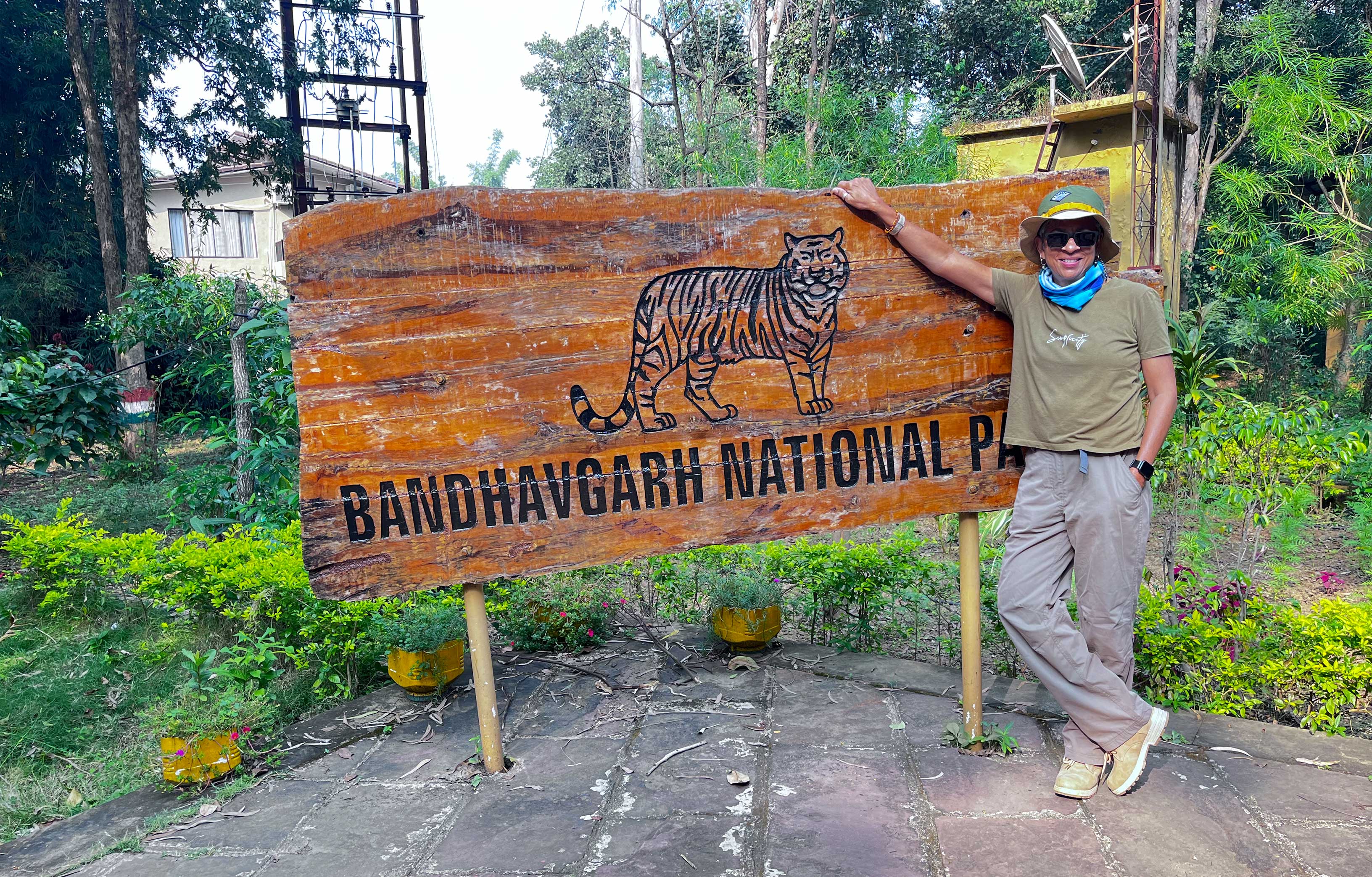
There is something about a wildlife adventure that gets the adrenaline going long before you reach the forest. The anticipation of what you might see, the excitement of searching for that elusive animal and, of course, the hope that the wildlife will cooperate. This time, eight of us were heading to Bandhavgarh National Park in Madhya Pradesh, India, one of the country’s most celebrated tiger reserves. We were hoping for some memorable tiger sightings. As it turned out, the tigers were more than accommodating. The airlines, however, were another story!
Our journey began in Colombo aboard SriLankan Airlines flight UL 191 to Delhi, where we were scheduled to connect with IndiGo’s 11.40 a.m. flight to Jabalpur. From there, a four-hour drive would take us to Bandhavgarh. A long day of travelling, certainly, but perfectly manageable. Or so we thought.
Somewhere along the way, IndiGo had decided that 11.40 a.m. was no longer a suitable departure time and had brought the flight forward to 7.40 a.m. Four hours earlier! Unfortunately, that meant our connecting flight had already departed by the time we reached Terminal One. So much for our carefully planned itinerary!


We were eventually rebooked on the 4.45 p.m. flight, leaving eight rather frustrated travellers with several unexpected hours to enjoy the delights of Delhi airport. Not exactly the wildlife experience we had signed up for! By the time we finally landed in Jabalpur and completed the four-hour drive to Bandhavgarh, it was late night.
Our home for the next two nights was the MPT White Tiger Forest Lodge, a convenient base for exploring the national park. At that hour, however, we weren’t particularly interested in exploring anything other than our beds. With an early morning safari ahead of us, sleep was going to be in rather short supply.
But who needs sleep when there are tigers waiting to be discovered?
Day 01


Bandhavgarh National Park is a fascinating landscape of sal forests, bamboo thickets, grassy meadows and rolling hills. Once the private hunting grounds of the Maharajas of Rewa, it became a national park in 1968 and later a tiger reserve under India’s Project Tiger initiative. Today, it is renowned for its relatively high concentration of Royal Bengal tigers, making it one of India’s most sought-after wildlife destinations. The reserve has three principal core safari zones – Tala, Magdhi and Khitauli – along with buffer areas that provide additional wildlife habitat.
Our first morning safari took us into Tala, considered one of the most scenic and historically interesting parts of Bandhavgarh.

We split into two safari jeeps, each with a capacity for six visitors. However, jeep allocations are also determined through the park’s lottery system, so there’s an element of luck involved even before you enter the forest!
It was a chilly start, but the excitement of entering the forest soon made us forget the early hour. There is something wonderfully exhilarating about those first moments on safari. Every rustle in the undergrowth demands attention, every movement among the trees has you searching, and every bend in the track holds the possibility of something extraordinary.
But before the tigers made their appearance, Bandhavgarh had a rather unexpected surprise for us.
Hidden deep within the Tala forest is Shesh Shaiya, a magnificent ancient sculpture of Lord Vishnu reclining on the seven-headed serpent Sheshnag. Carved out of a single rock and measuring approximately 35 feet in length, this remarkable sculpture is believed to date back to the 10th century.


We stopped to admire this extraordinary piece of history, surrounded by forest and accompanied by the gentle flow of a natural spring. It seemed almost surreal to find such an impressive archaeological treasure in the middle of tiger country.
Bandhavgarh itself has an interesting connection to Hindu mythology. According to legend, Lord Rama gifted the fort to his younger brother Lakshmana after returning from Lanka, and the name Bandhavgarh is said to mean “Brother’s Fort.”
And there was our Sri Lankan connection, right in the heart of an Indian tiger reserve! Who would have thought that between searching for tigers, we would find ourselves admiring a centuries-old sculpture and recalling a legend linking this forest to our own island?
Back on the safari trail, our attention returned to the surrounding vegetation. And then came the moment we had all been waiting for.
Two subadult tigers, partially concealed among the bushes!

Not one, but two! No one seems to have gotten a good photograph of the second, who was lying down with her feet in the air!
But there they were, young and beautiful, their distinctive stripes blending remarkably well with the surrounding vegetation. It is astonishing how an animal with such striking markings can almost disappear into the forest. We watched them intently, trying to make out every detail through the foliage.
For anyone who has spent time searching for wildlife, you will know that sightings are never guaranteed. Sometimes you spend hours scanning the forest and return with nothing more than a collection of photographs of trees. Fortunately, Bandhavgarh seemed determined to make our first day rather special.
And it wasn’t finished with us yet.
Our afternoon safari took us back into Tala, where we met Bajrang, a magnificent male Royal Bengal tiger. And what a sight he was! Of course, this was precisely when I wished I had my phone camera with me, but there was something wonderful about simply watching him, with no screen between us, and no fumbling for that perfect shot. Just Bajrang, in all his glory, and me, with a couple more jeeps of course, trying to take in every magnificent detail. I was confident that Nishanthi, Rajindra and Tharuka, with their DSLRs would capture these amazing photographs for us.


This wasn’t a fleeting glimpse through the bushes. We had an absolutely wonderful, up-close encounter with this handsome fellow, giving us the opportunity to admire him in all his glory. With his broad head, powerful shoulders and beautifully patterned coat, Bajrang, also known as the Silent Monarch of Bandhavgarh, was every inch the king of his domain. There is something quite extraordinary about being so close to a fully grown tiger in the wild. His sheer size and presence command your attention, and for those precious moments, everything else seems to fade into the background.
I found myself completely absorbed, watching his movements as he walked beside us, completely oblivious to our presence, and admiring the intricate pattern of stripes that makes every tiger unique. Photographs can capture their beauty, but they can never quite convey the feeling of being in the presence of such a magnificent animal in its natural habitat.
We were thrilled. Completely, utterly thrilled!
Two young tigers in the morning and the magnificent Bajrang in the afternoon. Three tigers on our very first day! Not bad for a group that had spent much of the previous day stranded at Delhi airport.
Day 02
The following morning, November 4, found us back in our jeeps, wrapped up against the early morning chill and ready for another adventure. After the previous day’s success, expectations were understandably high. Of course, wildlife doesn’t operate according to anyone’s itinerary, and I have learnt over the years that patience is an essential part of any safari.
This time, we headed into the Magdhi core zone, another important tiger habitat within Bandhavgarh.
And once again, the forest delivered!

We encountered Dhamokhar, affectionately known as DM. adding another tiger to our growing list of sightings.
DM was an impressive male, with the powerful build and imposing presence that make adult Bengal tigers such extraordinary animals to observe. Kanaudi, his sister was supposedly lurking close by and unfortunately I did not get a chance to spot her.
One of the fascinating things about Bandhavgarh is that many of its tigers are individually identified and known by name. Their territories, movements and family histories become part of the forest’s continuing story. Instead of simply returning home saying that you saw a tiger, you find yourself talking about Bajrang, DM and Kanaudi as though they were old acquaintances. And the more you learn about these magnificent animals, the more you appreciate the importance of protecting their habitat.
There was, however, an initial disappointment with our afternoon safari. Being a Wednesday, we did not know that the core zones of all national parks across India, including Bandhavgarh are closed to tourists on Wednesday afternoons. Fortunately, the buffer zones remain open, so our fourth and final safari took us into Panpatha.
Now, some visitors might consider a buffer-zone safari a consolation prize, particularly after enjoying such successful sightings in the core areas. But wildlife doesn’t recognise the boundaries drawn on tourism maps, and Panpatha was about to prove that rather spectacularly.
Here, we encountered an extraordinary close-up sighting of a solitary tiger identified as One Four One. According to our guide, he has yet to be given a name and is only identified by a number that traces his lineage.


Seeing a tiger in the distance is thrilling. But seeing one this close? I was spellbound. Those glorious stripes, that intense gaze, the sheer power of him! Meanwhile, he was looking at eight people sitting in front of him, all staring back as though we’d never seen a cat before. I wondered what he was thinking. “Tourists again?” “Why are they even here?” Or, more worryingly, “Lovely. Meals on wheels.” He sat, posed, stretched, yawned, gazed and then slowly slunk away, all the while, each of us were mesmerised by his sheer size and awesomeness.
And to think that our Wednesday afternoon safari in the buffer zone had produced one of the most memorable tiger encounters of the entire trip!
Although the tigers were undoubtedly the stars of our Bandhavgarh adventure, there was plenty of other wildlife to keep us entertained.


We encountered rhesus macaques, langurs, nilgai, also known as the blue bull, and numerous birds during our four safaris. The langurs were particularly entertaining, as monkeys so often are, while the nilgai, Asia’s largest antelope, added another interesting dimension to our sightings.
One of the things I enjoy most about being in the forest is that there is never a dull moment if you take the time to observe your surroundings. Even when the big cats are nowhere to be seen, there is always something happening. A bird calling from the canopy, a monkey leaping between branches or a sudden movement in the undergrowth can send everyone reaching for their cameras.
Back at the MPT White Tiger Forest Lodge we shared photographs, with plenty of stories to exchange. As always, there was much discussion about who had spotted what first, who had managed the best photograph and which tiger had been the most impressive.
For me, the majestic Bajrang and that unforgettable close encounter with One Four One were particularly special. But seeing those two young tigers tucked away in the bushes on our very first morning had been equally exciting.
Looking back, it had been quite an extraordinary start to our Indian wildlife adventure. Eight travellers, a missed connection, endless hours at Delhi airport, a near-midnight arrival and four incredible safaris that more than made up for all the inconvenience.
Tomorrow, we head to Panna National Park, hopefully, for more tiger encounters. But tonight, I can go to bed thoroughly satisfied, with wonderful sightings, unforgettable memories and more than a few hundred photographs to show for it!
Then again, when it comes to tigers, can you ever really have enough?


Our group: Rajindra Ariyabandu, Tharuka Dissanaike, Me, Nishanthi Perera, Vishaka Hidellage, Shireen Samarasuriya, Sureka Perera, and Madhavi Ariyabandu.
Photos by: Nishanthi Perera, Rajindra Ariyabandu and Tharuka Dissanaike
Fancy a little tiger spotting of your own? Let me organise a Mihipedia getaway for you! Get in touch and let’s plan your adventure. The tigers will make their own arrangements, of course.





Beautiful picture Mihiri
Thank you!