
And so, leaving Austria behind, I crossed into the Czech Republic by train, with Prague waiting to surprise me. Somehow, this chapter of my April 2016 European adventure had gone missing from Mihipedia. Ten years later, it was time to put that right!
Prague, its beautiful capital, turned out to be everything I had imagined and then some.
With its Gothic spires, medieval streets, grand squares and colourful buildings, it felt as though I had stepped into a history book, except that this one came with excellent coffee, cobblestone streets and plenty of opportunities to get happily lost.

My base for the next couple of days was the Grandior Hotel Prague, conveniently located in the New Town, making it a comfortable starting point for exploring the city.
Prague is a city best discovered on foot. Its historic centre is remarkably rich in architectural treasures, and every turn seems to reveal another church, palace, monument or charming little street. I decided to devote my first day to Prague Castle and the picturesque neighbourhood of Malá Strana, also known as Lesser Town.

My first stop was the magnificent Prague Castle, one of the city’s most recognisable landmarks and a place where centuries of Czech history unfold within an enormous complex of palaces, churches, courtyards and gardens.The first courtyard and entrance area of Prague Castle, with the unmistakable Gothic spires of St. Vitus Cathedral rising dramatically in the background. The castle dates back to the 9th century and has served as the seat of Czech rulers, kings and presidents. It is often described as one of the largest ancient castle complexes in the world, and it certainly felt more like a small historic town than a single castle.
As I made my way through the entrance, I was immediately struck by the grandeur of the surroundings.

The Archbishop’s Palace on Hradčanské náměstí, an imposing Baroque landmark that adds to the regal character of the castle district. The square itself is surrounded by palaces and historic buildings, each with its own story. It is easy to imagine royal processions and distinguished visitors making their way through these very streets centuries ago.

A panoramic view over the red-tiled rooftops of Prague, with the distinctive green domes of St. Nicholas Church in Malá Strana.


Another spectacular elevated view of Prague from a terrace near the castle. The city’s sea of terracotta rooftops, punctuated by church towers and domes, was quite a sight. I could have stood there for ages, simply taking in the view. Prague is often called the City of a Hundred Spires, although looking at this panorama, I suspected someone had stopped counting rather early!


One of the historic courtyards within the Prague Castle complex, where the architectural details are as impressive as the scale of the buildings.

No visit to Prague Castle would be complete without exploring St. Vitus Cathedral.


The ornate western facade and grand rose window, a striking example of medieval craftsmanship. Construction began in 1344 under the direction of Emperor Charles IV, although the cathedral was not completed until 1929. That is nearly six centuries of building, rebuilding and architectural ambition! The cathedral has witnessed royal coronations, weddings and funerals, and houses the tombs of several Bohemian kings and Holy Roman Emperors. Its stained-glass windows, soaring vaulted ceilings and elaborate chapels make it an extraordinary place to explore.
I found myself looking up constantly, marvelling at the sheer scale of the structure and the incredible patience of the craftsmen who created it.

Within the castle complex, I also came across the beautiful St. George’s Basilica. The distinctive red Baroque facade and white towers of St. George’s Basilica, one of the oldest surviving church buildings in Prague. Founded in the 10th century, the basilica offers a fascinating contrast to the grandeur of St. Vitus Cathedral. Its Romanesque origins and later Baroque additions reflect the many architectural periods that have shaped Prague.

The Chapel of the Holy Cross in the second courtyard of Prague Castle, an elegant building that adds another layer to the complex’s rich architectural history.

The entrance to the Supreme Burgraviate, a historic part of the castle that once housed the Toy Museum.

The bronze sculpture Youth by Czech sculptor Miloš Zet, formerly displayed outside the Toy Museum. There was something rather delightful about discovering these smaller details amid the monumental buildings. Prague Castle was not merely about kings and grand architecture; it was also a collection of unexpected little discoveries.
Having explored the castle, I began making my way downhill towards Malá Strana, one of Prague’s most charming historic neighbourhoods.


Nerudova Street, a picturesque cobblestone thoroughfare lined with historic buildings, ornate doorways and colourful facades. Named after Czech writer Jan Neruda, the street was once part of the Royal Route used by Bohemian kings on their way to Prague Castle for coronation ceremonies. One of its most fascinating features is the collection of traditional house signs. Before modern street numbering became widespread, buildings were identified by symbols such as lions, keys, eagles and other distinctive emblems.
I found myself slowing down repeatedly, looking at the doorways, windows and architectural details. This was the sort of street where the journey itself was the attraction.

At the heart of Lesser Town lies St. Nicholas Church, one of Prague’s most impressive Baroque landmarks. The magnificent St. Nicholas Church, alongside the historic Holy Trinity Column in Malostranské náměstí.

The Holy Trinity Column standing proudly in Lesser Town Square, in front of the church.
The church’s enormous green dome dominates the surrounding rooftops, while its elaborate interior is famous for its frescoes, sculptures and ornate decoration. The square itself is a lovely place to pause, admire the architecture and watch everyday Prague life unfold around centuries-old buildings.
As I wandered through the neighbourhood, I came across the historic House at the Three Carps.

The House at the Three Carps, also associated with the former sign of the Vinárna U palcátu wine bar, on Thunovská Street. Historical event programs from the mid-19th century highlight it as a cultural venue for musical acts, such as hosting performances by the notable Czerny Sextet in 1857. In modern times, the site is known within urban exploration circles as a photogenic, historic property. It was another reminder of how Prague’s history is woven into ordinary buildings, not just its famous monuments.
One of the most memorable stops of my day was the Church of Our Lady Victorious, home to the famous Infant Jesus of Prague which I happened to stumble upon by chance!


Inside, I found the shrine of the Infant Jesus, a small wax-coated wooden statue of the Christ Child that has attracted pilgrims from around the world for centuries. The Early Baroque Church of Our Lady Victorious and St Anthony of Padua in Malá Strana, originally built in 1611, was rebuilt by the Carmelite Order between 1634 and 1669. The church is famous for its statuette of the Infant Jesus of Prague, originally from Spain and donated to the Carmelites by Polyxena of Lobkowicz in 1628. The Infant Jesus has three crowns and more than one hundred robes. His vestments are traditionally changed about ten times a year according to the liturgical season. A small museum was built to display the garments and other religious objects.


One of the interesting traditions surrounding the Infant Jesus is the changing of its garments according to the liturgical calendar and religious occasions. The collection includes robes donated by devotees from different parts of the world. Even for a traveller primarily interested in architecture and history, this was a fascinating glimpse into Prague’s religious traditions and enduring devotion.
By now, I was well and truly immersed in the atmosphere of Lesser Town.

With its old-world character and medieval associations, the tavern looked like the sort of place where one might expect a knight to walk in and order dinner. Prague certainly knows how to preserve its sense of theatre!
My walk continued towards Kampa Island, a delightful area beside the Vltava River, separated from the mainland by the narrow Čertovka waterway.


The canal is sometimes referred to as Prague’s Little Venice, and I could see why. Its waters, old buildings and little bridges create a rather enchanting corner of the city.


Nearby was the Archibald At the Charles Bridge, another charming historic property.
As the day progressed, I made my way towards the iconic Charles Bridge. Built in the 14th century during the reign of Charles IV, the bridge connects the Old Town with Lesser Town and is lined with an impressive collection of Baroque statues.


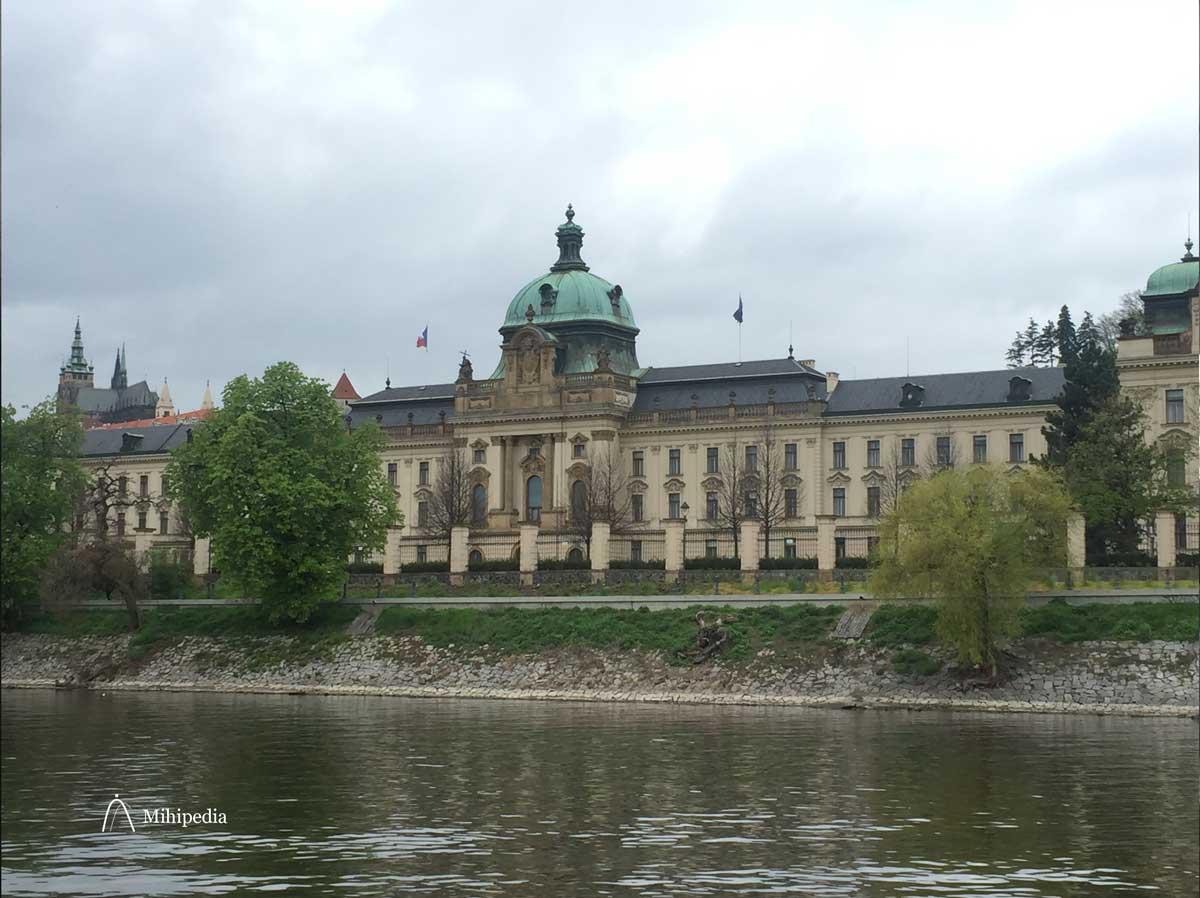
A scenic view along the Vltava River, with historic architecture lining its banks and a sightseeing boat cruising along the water.

Built in the 14th century during the reign of Charles IV, the bridge connects the Old Town with Lesser Town and is lined with an impressive collection of Baroque statues. It is one of those places where history, architecture and everyday life come together beautifully. Artists, musicians, visitors and locals all share the same historic walkway, creating a lively atmosphere against the backdrop of the river and castle.
After a full day of walking, exploring and photographing, I was more than ready to return to the Grandior Hotel and put my feet up.
Prague had already made quite an impression, and I still had another day to discover its treasures.


1 good vibe