After yesterday’s castle adventure, I was ready to explore the other side of Prague: its historic Old Town, grand civic buildings, medieval squares and fascinating riverside architecture. I set off from the Grandior Hotel, heading towards the Vltava and the historic centre.
The beauty of Prague is that its major attractions are relatively close to one another, making it possible to explore much of the historic centre on foot, provided one is prepared for plenty of cobblestones!

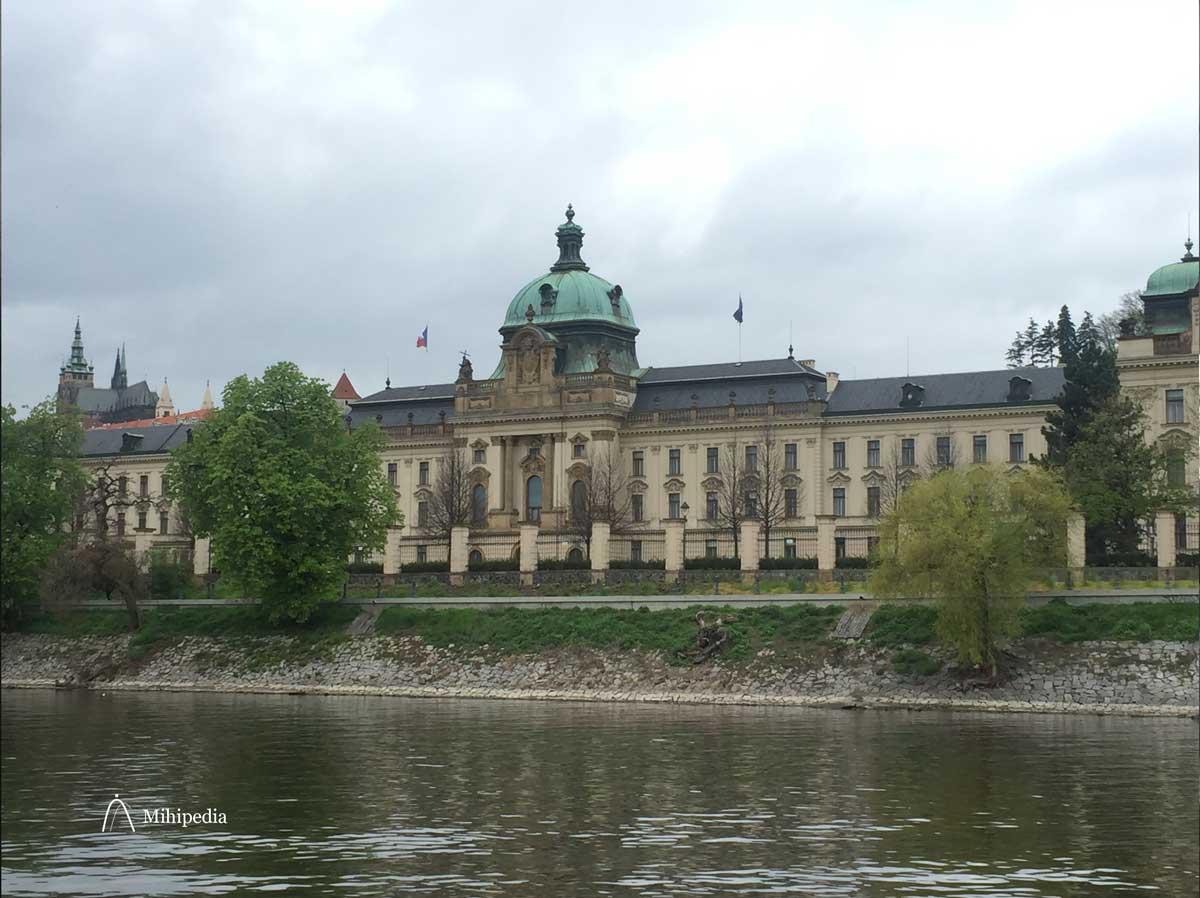
The Straka Academy is one of those buildings that makes you stop and take a second look. Sitting right on the banks of the Vltava, this beautiful Neo-Baroque building is hard to miss. Today, it is home to the Czech Government, although I suspect the politicians appreciate the grand surroundings as much as visitors do!

I come across the historic Štvanice Hydroelectric Power Plant, located on the western tip of Štvanice Island. It was interesting to discover this piece of Prague’s industrial heritage amid the city’s better-known palaces and churches.
Making my way towards the Old Town side of Charles Bridge, I came across the statue of Charles IV.

Just near the eastern end of Charles Bridge, I came across the Neo-Gothic monument to Charles IV at Křižovnické Square. Charles IV was a pretty important figure in Prague’s story. During his reign, the city grew into a major political and cultural centre, and he founded Charles University in 1348, which is still going strong today. Looking around Prague, it isn’t hard to see his influence. So much of the city’s grand architecture and historic character can be traced back to his vision.

St. Salvator Church, part of the historic Klementinum complex, caught my eye as I wandered through this part of the Old Town.

The Klementinum is an enormous historic complex that today houses the National Library of the Czech Republic. It started life as a Jesuit college and, over the centuries, grew into an important centre of learning in Prague.
I loved the mix of beautiful Baroque architecture and the stories behind it. What really caught my attention, though, was its connection with astronomy. The Klementinum has a long history of astronomical observations, and it was fascinating to think that people were studying the skies here centuries ago.
There seemed to be history everywhere I looked in Prague — and the Klementinum was another wonderful example.

Nearby stood the New City Hall. Despite its name, the building is now more than a century old. It is an elegant addition to the architectural mix of Prague’s historic centre.

The facade of the Municipal Library of Prague, is another notable building on Mariánské náměstí.

And then I arrived at Old Town Square, one of those places in Prague where you simply stop and look around. The twin Gothic spires of the Church of Our Lady before Týn dominate the skyline, while the Jan Hus Memorial stands proudly in the square. This has been the heart of Prague for centuries, and it’s easy to imagine the markets, celebrations, political gatherings and all the drama that has played out here over the years.
The Church of Our Lady before Týn is particularly impressive. Its twin towers rise high above the surrounding rooftops, although if you look closely, you’ll notice they aren’t quite identical. Somehow, that only adds to its character.
Standing there, surrounded by all those beautiful old buildings, I finally understood why Prague has such a hold on travellers. Everywhere you look, there is another building, another story or another photograph waiting to be discovered.


And then there was Prague’s famous Astronomical Clock, or Orloj, attached to the Old Town Hall. Dating back to 1410, it is one of the world’s oldest astronomical clocks still in operation. This is certainly no ordinary clock. Its elaborate dial shows the positions of the Sun and Moon, while another dial keeps track of the months and days. And then, on the hour, the little mechanical figures come to life.
Naturally, I wasn’t going to miss that! I joined the crowd of visitors waiting, cameras at the ready, for the hourly performance. After all, you can’t come all the way to Prague and not stand around waiting for a 600-year-old clock to put on a little show!

From the medieval charm of Old Town, I soon found myself looking at something completely different — the magnificent Municipal House, or Obecní dům, near the Powder Tower. This is Prague’s Art Nouveau at its best, with an ornate facade, decorative mosaics and plenty of elegant little details that kept catching my eye. The building is also a major cultural venue, hosting concerts, exhibitions and other events.
What struck me most was the contrast. Not long before, I had been surrounded by Gothic towers and medieval buildings, and now here was this graceful early-20th-century masterpiece, with its flowing lines and elaborate decoration.
Prague really does seem to have a knack for putting centuries of architecture side by side — and somehow making it all work.

And Prague had another surprise in store for me that evening — Swan Lake. I had already bought my tickets months in advance because I love performing arts, and couldn’t resist going to see the ballet.
After a day of walking through castles, churches and historic squares, it was quite a change of pace to spend the evening watching Tchaikovsky’s famous ballet. The performance was a wonderful reminder that Prague isn’t just about beautiful buildings and medieval history. Music, theatre, ballet and the arts are very much part of the city’s character too.
And there I was, in Prague in 2016, watching Swan Lake — another lovely memory to add to an already rather full European adventure.

The House at the Minute, a beautiful Renaissance building decorated with intricate black-and-white sgraffito designs. Located near Old Town Square, this historic building is particularly notable for its elaborate exterior decoration. It was also once associated with the family of writer Franz Kafka, who lived here during his childhood. I love discovering these little connections between buildings and the people who once inhabited them. They make a city feel less like a collection of monuments and more like a living story.

The Jan Hus Memorial in Old Town Square, a powerful monument honouring the Czech religious reformer and philosopher. Jan Hus was a 15th-century reformer whose criticism of corruption within the Church led to his execution in 1415. His ideas later influenced the Protestant Reformation and became an important part of Czech national identity. The monument, unveiled in 1915 to mark the 500th anniversary of his death, depicts Hus and other figures associated with Czech history.
It was a fitting final stop on my exploration of Prague, a city whose past is filled with remarkable personalities, artistic achievements, political struggles and enduring traditions.
Two days in Prague had given me a wonderful introduction to the Czech capital, although I knew I had barely scratched the surface.
From the grandeur of Prague Castle and the soaring Gothic architecture of St. Vitus Cathedral to the winding lanes of Malá Strana, the peaceful canals of Kampa and the lively atmosphere of Old Town Square, every part of the city offered something different. What I particularly loved was the way Prague wears its history so effortlessly. Medieval, Gothic, Baroque, Renaissance and Art Nouveau architecture coexist, not as museum pieces but as part of everyday life.
And, of course, there were the cobblestone streets, charming little cafes, beautiful river views and countless opportunities to stop and take yet another photograph.
As I continued my European journey, Prague remained one of those destinations that reminded me why I travel in the first place: not simply to tick countries off a list, but to discover places, their stories and the little details that stay with me long after I have moved on. Prague, you were certainly worth the detour.
My two days in Prague brought my European adventure to a fitting close. From here, it was a train ride back to Frankfurt, where I would board my flight home to Sri Lanka.

As the train carried me through the European countryside, I couldn’t help looking back at the incredible journey I had just completed. Germany, Austria, Slovenia, Slovakia, Hungary and the Czech Republic had all featured in this April 2016 adventure, with each country offering its own distinctive charm, history and experiences.
There had been plenty of walking, sightseeing, getting acquainted with unfamiliar transport systems, navigating new streets and, naturally, taking far too many photographs. But isn’t that what travelling is all about?
By the time I reached Frankfurt, I was ready to head home, even if a little reluctant to leave.
Looking back, this was more than just a holiday across several European countries. It was another reminder that the world is full of places waiting to be discovered, stories waiting to be heard and experiences waiting to be lived. And if there is one thing I have learnt from all my travels, it is that the end of one journey is simply the beginning of planning another.
Until then, keep wandering!