Day 7 | November 8, 2026
After breakfast at the Ramada Hotel, we were back in our comfortable Force Urbania van by 9 a.m., heading towards Orchha, a historic little town in Madhya Pradesh, renowned for its magnificent palaces, forts, temples and royal cenotaphs. But there was an added excitement to our journey today. It was the Diwali festive season, and everywhere we looked, India seemed to be in celebration mode.


The four-hour drive took us through rural Madhya Pradesh, where the streets were bursting with colour and creativity. Shops were decorated with colourful garlands, strings of lights and festive ornaments, while brightly coloured powders, flowers, earthen oil lamps and boxes of sweets added to the cheerful atmosphere. Intricate rangoli patterns, traditionally created using coloured powders, rice and flower petals, decorate the entrances of homes and businesses during this time, welcoming prosperity and good fortune. It was lovely to see the preparations and the enthusiasm with which people were celebrating one of India’s most important festivals.

Diwali, or Deepavali, meaning a row of lights, celebrates the triumph of light over darkness, good over evil and knowledge over ignorance. Although the festival has different religious and regional interpretations across India, one of its best-known legends comes from the ancient Hindu epic, the Ramayana.
According to the epic, Prince Rama of Ayodhya was banished into exile for fourteen years, accompanied by his devoted wife Sita and younger brother Lakshmana. During their exile, Sita was abducted by Ravana, the powerful king of Lanka. With the assistance of Hanuman and his army, Rama eventually defeated Ravana, rescued Sita and returned triumphantly to Ayodhya. Legend tells us that the people of Ayodhya illuminated the entire kingdom with thousands of earthen lamps to welcome their beloved prince home.
And here we were, a group of Sri Lankans travelling through India during a festival that celebrates one of the most famous stories connecting our two countries! Of course, depending on which side of the Palk Strait you happen to be on, the story of Ravana can take on a somewhat different perspective! So, we decided to stay quiet about our relationship to Ravana!

What made our destination even more special was that Orchha is renowned as a place where Lord Rama is worshipped not merely as a deity, but as a reigning king. We couldn’t have chosen a more appropriate time to visit.
Orchha – A Kingdom Frozen in Time
Founded in the early 16th century by the Bundela Rajput ruler Rudra Pratap Singh, Orchha was once the capital of a powerful kingdom. Its name is said to mean ‘hidden place’, an appropriate description for a town nestled along the banks of the picturesque Betwa River.
Unlike some of India’s larger and busier historical destinations, Orchha has managed to retain much of its small-town character. Its skyline is dominated by ancient palaces, towering temple spires and domed pavilions, offering a glimpse into an era when the Bundela rulers held sway over this part of Central India.


By the time we arrived in Orchha, lunch was very much on everyone’s mind. Our lunch venue was Bundelkhand Riverside, a former royal hunting lodge now converted into a heritage hotel on the banks of the Betwa River. With its brightly painted yellow walls, deep maroon pillars, ornate window frames and long verandahs overlooking the gardens, the property had an unmistakable old-world charm. The dining room was particularly interesting, with its beautifully patterned floor tiles, decorative mirrors, wooden furniture and hanging lanterns, all reminiscent of a bygone era. Admittedly, the property looked a little tired and could probably do with some royal attention of its own! Thankfully, the food was good, and after a satisfying lunch, we were ready to explore the architectural treasures of Orchha.
Exploring the magnificent Orchha Fort Complex

Standing on an island formed by the Betwa River and its channels, the Orchha Fort Complex is an impressive collection of palaces, courtyards, temples and royal residences constructed over several generations of Bundela rule. Its architecture is a fascinating blend of Rajput and Mughal influences, reflecting both the artistic sophistication of the period and the complex political relationships between the Bundela rulers and the Mughal emperors.
Two of its most impressive structures are the Raja Mahal and Jahangir Mahal, each with its own distinctive character and history.
Raja Mahal – A Palace of Painted Stories

At the entrance to Orchha Fort, we were met by a rather impressive-looking guide whose traditional attire made him look as though he had stepped straight out of medieval India. He certainly looked the part, and for a moment, it felt as though we were being personally escorted into the royal kingdom of the Bundelas!
The Raja Mahal, or King’s Palace, was developed during the 16th century and served as a royal residence. From the outside, it has a relatively restrained, fortress-like appearance, but step inside and an entirely different world unfolds.


The palace is particularly renowned for its beautiful murals, which adorn the walls and ceilings of the royal chambers. These paintings depict scenes from Hindu mythology, including episodes from the lives of Lord Rama and Krishna, alongside hunting scenes, courtly life and other aspects of the medieval royal world.

What fascinated me was the extraordinary detail of these paintings. Despite the passage of centuries, traces of their rich colours and intricate designs remain visible. The artists cleverly incorporated the architectural features of the rooms into their compositions, transforming the walls and ceilings into elaborate illustrated narratives.


Walking through the palace’s courtyards, narrow passages and former royal chambers, I found myself wondering what life must have been like within these walls when Orchha was at the height of its power. Today, the rooms stand largely empty, but the paintings offer tantalising glimpses into the lives, beliefs and artistic tastes of their former occupants.
Jahangir Mahal – A Palace Fit for an Emperor
If Raja Mahal impressed with its murals, Jahangir Mahal was all about architectural grandeur.

Built in the early 17th century by the Bundela ruler Bir Singh Deo, the palace is traditionally associated with a visit by the Mughal Emperor Jahangir. It was an extraordinary gesture of royal hospitality, reflecting the close relationship between the two rulers.
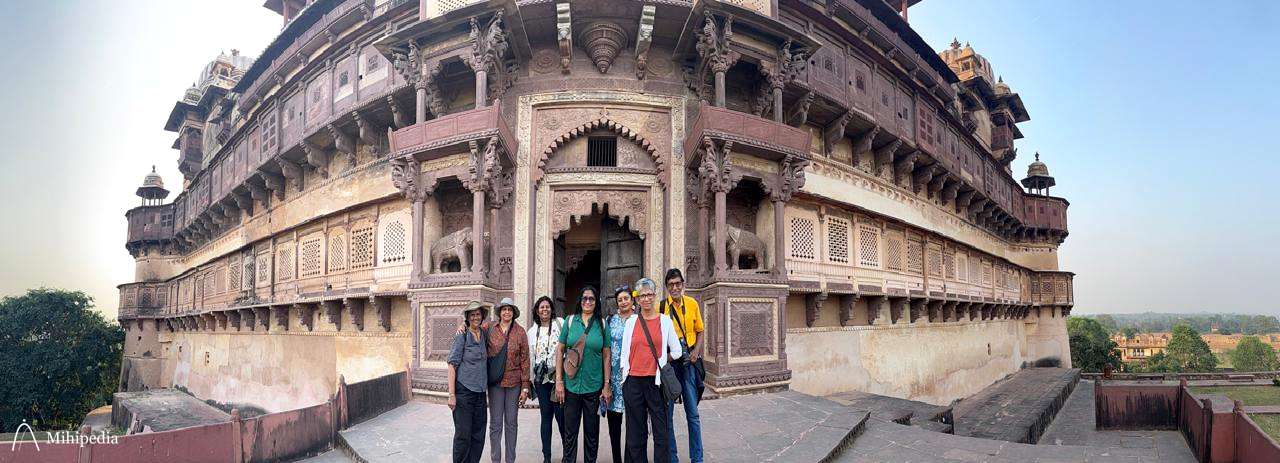
The palace is an imposing three-storey structure, with a vast central courtyard surrounded by ornate balconies, arched doorways, domed pavilions and intricately carved stonework. The distinctive chhatris, or umbrella-shaped pavilions, crown its towers, while decorative brackets, latticework and overhanging balconies add elegance to its otherwise rather formidable appearance.

What makes Jahangir Mahal so visually striking is the balance between grandeur and intricate detailing. Mughal-inspired arches and geometric designs sit alongside traditional Rajput architectural elements, creating a harmonious fusion of two artistic traditions. From its upper levels, the views extend across Orchha’s remarkable skyline, taking in ancient temples, palaces and the surrounding countryside.
Interestingly, local tradition claims that Emperor Jahangir spent just one night in this magnificent palace. Imagine constructing an entire palace for a guest who stays for only one night! Clearly, royal hospitality in those days operated on an entirely different scale!
The Royal Chhatris Along the Betwa River
From the fort complex, we made our way towards one of Orchha’s most distinctive and photographed landmarks – the royal cenotaphs, or chhatris, standing majestically along the banks of the Betwa River.


There are fourteen royal cenotaphs in this riverside collection, built in memory of the Bundela rulers and members of their royal families. The word chhatri translates as ‘umbrella’, referring to the domed, umbrella-shaped architectural features commonly seen in Rajput buildings.
Unlike conventional tombs, these structures are commemorative monuments associated with the cremation traditions of Hindu royalty. Their towering, temple-like forms, elaborate spires and imposing stone façades were designed to honour the memory and status of the rulers for whom they were built.

Among the most prominent is the cenotaph of Bir Singh Deo, the same ruler responsible for Jahangir Mahal. Each monument has its own architectural character, although together they create an extraordinary skyline that has become synonymous with Orchha.
There is something particularly atmospheric about these monuments. Their weathered stone surfaces, enormous proportions and riverside setting lend them an almost haunting beauty. Once built to commemorate powerful kings, they now stand as silent reminders of a bygone era.

Interestingly, these ancient structures have also found new occupants. Orchha’s cenotaphs provide nesting and roosting sites for vultures, particularly the critically endangered Indian vulture. Having learnt about India’s vulture conservation efforts the previous day at Panna, it was fascinating to discover another connection between the country’s architectural heritage and wildlife conservation.
Who would have thought that the centuries-old memorials of Bundela kings would one day become valuable refuges for some of India’s most threatened birds?
Diwali at the Ram Raja Temple – Where God Is King

For me, one of the most memorable experiences of our visit to Orchha was participating in the evening pooja at the famous Ram Raja Temple during the Diwali celebrations.
The story behind this temple is quite fascinating. According to local legend, Queen Ganesh Kunwari, the wife of Raja Madhukar Shah, was a devoted follower of Lord Rama. She travelled to Ayodhya, eventually bringing an image of Rama back to Orchha. However, there was a condition: wherever the deity was first placed, he would remain.
The magnificent Chaturbhuj Temple was intended to house the image, but as its construction was not yet complete, the queen temporarily placed it in her palace. When the time came to move the deity to the new temple, it proved impossible to do so. The queen’s palace consequently became the Ram Raja Temple, and Lord Rama came to be regarded as the sovereign ruler of Orchha.
To this day, Rama is accorded the privileges and ceremonial honours of a reigning monarch. The temple follows a royal daily routine, complete with designated times for waking, meals, rest and evening worship. Five uniformed police guards are assigned to the temple, and a formal guard of honour is part of its distinctive tradition.
The evening pooja, known as the Sandhya Aarti, is a beautiful Hindu ritual in which light is offered to the deity. Priests traditionally perform the ceremony by moving illuminated oil lamps in circular motions before the sacred image, accompanied by devotional singing, prayers, the ringing of bells and the fragrance of incense. The flame symbolises divine light, and the ritual is an expression of gratitude, reverence and devotion.
What makes the ceremony at Orchha particularly unusual is the royal salute offered to Lord Rama by five uniformed guards, acknowledging his status as the town’s king. It is a tradition that brings together religious devotion and royal protocol in a rather extraordinary way.
Joining the evening pooja alongside the local devotees during the Diwali festivities was a wonderful cultural experience. There is something very special about participating in a religious celebration in the place where its traditions hold such deep significance, rather than simply observing it as a tourist.
For us Sri Lankans, having grown up familiar with the story of the Ramayana, it added yet another layer of interest to the experience. Here was an ancient epic that continues to influence the beliefs, traditions, festivals and everyday lives of millions of people, thousands of years after its story was first told.

It was certainly one of those travel experiences that no museum or history book could quite replicate.
What I particularly enjoyed about Orchha was the way its history seemed to coexist so naturally with everyday life. The palaces may no longer house kings, and the cenotaphs may stand silent along the river, but centuries-old traditions continue to thrive in the temples, streets and hearts of its people. And visiting during the Diwali festivities had made it all the more memorable.
Tomorrow, we check out of the Orchcha Resort and would be heading towards Gwalior to explore yet another magnificent fort before boarding our train to Delhi. Another chapter of our Central Indian adventure awaited us.
India, it seems, has no shortage of stories to tell. And I am certainly not done listening!

P.S. Meanwhile, running parallel to our sightseeing adventures was a highly classified procurement mission. Although Madhavi had left us in Khajuraho for Bangkok, her presence continued to be felt through a very specific assignment entrusted to Rajindra – to procure stainless steelware of a particular brand, size and quality from Delhi. A frantic, deliberate and deeply concentrated search was underway, with absolutely no room for creative interpretation. Madhavi – precise, methodical and decidedly particular – had to be pleased. Geographical distance had done little to diminish her supervisory powers! In retrospect, tracking down six tigers in Bandhavgarh may have been considerably easier!