After an unforgettable first day discovering the Eiffel Tower, the Arc de Triomphe and some of Paris’ most famous landmarks, Day Two took me on a journey through elegant boulevards, grand squares and centuries of French history.
One of the things I loved most about Paris was how effortlessly one beautiful location flowed into the next.
A leisurely walk would often lead from a quiet street to an iconic monument, with fascinating discoveries waiting around every corner.

My morning began in the elegant 7th arrondissement at the beautiful Holy Trinity Cathedral and Russian Orthodox Spiritual and Cultural Center. Standing close to the River Seine, the complex immediately catches your eye with its brilliant white stone walls and five gleaming golden domes that shimmer against the Paris skyline. Designed by renowned French architect Jean-Michel Wilmotte, the cathedral beautifully blends contemporary French architecture with traditional Russian Orthodox design. Opened in 2016, it serves not only as a place of worship but also as a cultural centre promoting Russian art, language and history. The contrast between its modern architecture and the centuries-old Parisian buildings surrounding it makes it one of the city’s more unusual landmarks.

Just a short walk away lies the modest Place de la Résistance. Unlike many of Paris’ grand monuments, this small square is easy to overlook, yet its name carries enormous historical significance. It honours the courageous men and women of the French Resistance, who fought against Nazi occupation during the Second World War. Standing here was a quiet reminder that throughout Paris, history isn’t confined to museums. Sometimes it is simply commemorated by a street sign or a peaceful square tucked among elegant buildings.
From the Left Bank I made my way back towards central Paris and one of its most elegant districts. Walking along Rue de la Paix, it was easy to understand why this street has long been associated with luxury. Beautiful Haussmann buildings line the avenue, while internationally famous jewellers and fashion houses occupy many of the historic storefronts


At the end of the street, the magnificent Place Vendôme opens into one of the most beautiful squares in Paris. At its centre rises the impressive Vendôme Column, commissioned by Napoleon Bonaparte after his victory at the Battle of Austerlitz in 1805. Completed in 1810, the bronze column was inspired by Trajan’s Column in Rome and is covered with spiral bronze reliefs cast from captured enemy cannons. At the very top stands a statue of Napoleon dressed as a Roman emperor, reinforcing his desire to associate himself with the great rulers of antiquity.
Surrounded by elegant classical façades and some of the world’s most prestigious luxury boutiques, Place Vendôme perfectly combines French history, architecture and sophistication. It is one of those places where every direction offers another beautiful photograph, and it was impossible not to stop and admire its timeless elegance.

Standing proudly on the banks of the River Seine on the historic Île de la Cité, the Conciergerie is one of Paris’ most remarkable medieval landmarks. With its imposing Gothic architecture, distinctive round towers and commanding riverside setting, it is hard to believe that this magnificent building has witnessed nearly a thousand years of French history.
Originally constructed as part of the Palais de la Cité, the residence of the Kings of France from the 10th to the 14th centuries, the Conciergerie later became one of the most feared prisons during the French Revolution. Its most famous prisoner was Queen Marie Antoinette, who spent her final weeks here before being taken to the guillotine in 1793.
Today, the building stands as both a monument to medieval Paris and a reminder of one of the most turbulent chapters in French history. Walking past its ancient stone walls and towers overlooking the Seine, I couldn’t help imagining the countless royal ceremonies, political intrigues and dramatic events that unfolded here over the centuries. It is one of those places where history feels incredibly alive.


Just a short stroll from the Conciergerie brought me to one of the world’s most celebrated landmarks, Notre-Dame de Paris. Standing majestically on the Île de la Cité, this masterpiece of French Gothic architecture has watched over Paris for more than eight centuries. Its magnificent western façade, with its twin towers, intricate rose window and three beautifully carved portals, is a showcase of medieval craftsmanship and artistic brilliance.
Construction began in 1163 during the reign of King Louis VII and continued for almost two centuries before the cathedral was finally completed around 1345. Throughout its long history, Notre-Dame has witnessed royal coronations, national celebrations, revolutions, wars and the liberation of Paris. It has also survived one of its greatest modern challenges, the devastating fire of 15 April 2019 (one year after I visited) , which destroyed the iconic spire and much of the roof. After years of painstaking restoration, the cathedral has once again welcomed visitors, making my visit feel even more special. Seeing this extraordinary symbol of Paris standing proudly beside the Seine was a truly unforgettable moment.

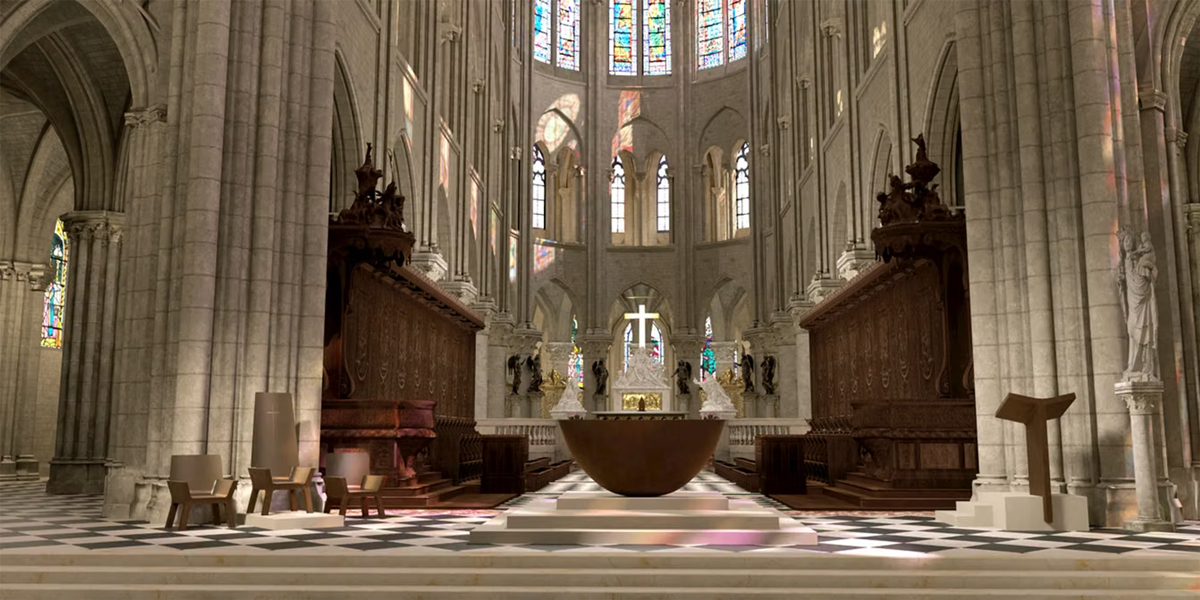
Stepping inside Notre-Dame de Paris, I was immediately struck by the sheer scale of the cathedral. Towering stone columns rise effortlessly towards soaring ribbed vaults, while pointed Gothic arches guide your eyes towards the distant altar. Sunlight filtering through magnificent stained-glass windows filled the vast interior with a gentle glow, creating a peaceful atmosphere that encouraged visitors to slow down and simply admire the beauty around them. It is impossible not to appreciate the extraordinary skill of the medieval craftsmen who created this architectural masterpiece more than 800 years ago.


Among the cathedral’s many treasures are the magnificent stained-glass windows in the apse. Created during the 19th-century restoration led by the renowned architect Eugène Viollet-le-Duc, they glow with rich shades of blue, crimson and gold. The intricate tracery and beautifully painted biblical figures fill the eastern end of the cathedral with colour and light. Standing beneath them, I could fully appreciate why stained glass is often described as one of the defining features of Gothic architecture.

At the heart of Notre-Dame stands the magnificent Pietà by French sculptor Nicolas Coustou, carved between 1712 and 1728. The white marble sculpture depicts the Virgin Mary tenderly mourning the body of Christ, creating one of the cathedral’s most moving works of art. Positioned beneath the great golden cross and framed by colourful stained-glass windows, the Pietà is flanked by kneeling statues of King Louis XIII and King Louis XIV. Together they create an inspiring focal point that beautifully combines sculpture, faith and architecture.

Looking east along the cathedral’s vast nave, I was once again amazed by the extraordinary scale of Notre-Dame. Massive clustered columns support elegant ribbed vaults that seem to disappear into the ceiling high above. Rows of wooden pews, hanging chandeliers and the soft glow of carefully placed lighting create an atmosphere of quiet reverence. It is one of those places where you instinctively lower your voice, allowing the beauty of the architecture to speak for itself.


Another remarkable feature inside Notre-Dame is the beautifully carved choir enclosure. These magnificent stone reliefs depict scenes from the life of Christ and the Apostles with extraordinary detail, transforming biblical stories into works of sculpture. The craftsmanship is astonishing. Every figure, expression and flowing garment has been carefully carved into the stone, making it easy to lose track of time while examining each individual panel.

Among the most fascinating reliefs are those illustrating the Apparitions of the Risen Christ following the Resurrection. The medieval carvings portray Christ appearing to Saint Thomas, meeting the Apostles beside the Sea of Tiberias, appearing in Galilee, and finally ascending into heaven. These beautifully preserved sculptures offer a remarkable glimpse into medieval religious storytelling, where biblical history was communicated through art as much as through words.

Notre-Dame also houses many remarkable funerary monuments, including the elegant marble memorial to Cardinal Jean-Baptiste de Belloy, Archbishop of Paris. The graceful Neoclassical composition portrays the elderly cardinal seated with an open book, surrounded by allegorical and religious figures carved from brilliant white marble. It is one of those quieter masterpieces that many visitors walk past, yet it adds another fascinating layer to the cathedral’s artistic heritage.

Before leaving, I spent time admiring the magnificent Portal of St. Anne, the oldest of the three great portals on Notre-Dame’s western façade. Dating from the 12th century, it preserves some of the cathedral’s earliest sculpture and beautifully illustrates the transition from the Romanesque style to the emerging Gothic tradition.
At its centre, the tympanum depicts the Virgin and Child, surrounded by angels, a bishop and a king, while richly carved arches frame the entrance with intricate biblical scenes. Standing before these weathered carvings, I couldn’t help but marvel that generations of Parisians and pilgrims have passed beneath this doorway for more than eight centuries. It was the perfect way to end my visit to one of the world’s greatest cathedrals.


Just outside Notre-Dame Cathedral, set into the cobbled square, lies the Point Zéro des Routes de France, a small bronze compass rose marking the official point from which all road distances in France are measured. Although many visitors walk past without noticing it, this modest marker is one of Paris’s most symbolic landmarks. According to local tradition, anyone who stands on the marker and makes a wish is destined to return to Paris one day. Naturally, I couldn’t resist taking part in the tradition, hoping that this wouldn’t be my last visit to the City of Light.

As another unforgettable day in Paris came to an end, I realised just how much history, culture and beauty I had experienced in a single day. From grand monuments and elegant boulevards to medieval landmarks and the timeless splendour of Notre-Dame, every corner of the city had revealed another fascinating chapter of its story. Yet the highlight of my Paris adventure was still to come.










1 good vibe