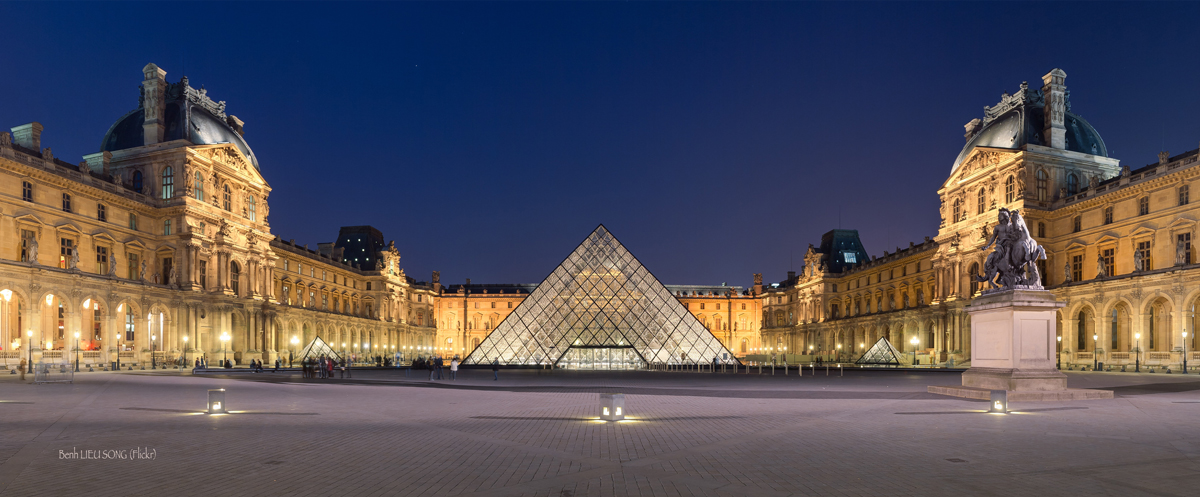
There are some places you visit simply because they are famous. And then there are places you visit because, for years, you have dreamed of standing there. For me, the Louvre Museum was definitely the second kind.
After yesterday’s wander through Montmartre, I was finally ready to spend a day exploring the treasures hidden behind those magnificent palace walls. As someone who has always been fascinated by history, art and architecture, I knew that the Louvre would be overwhelming. What I didn’t expect was how personal the experience would feel.
Every gallery seemed to open another window into the human story – our beliefs, our ambitions, our ideas of beauty, our triumphs and even our tragedies.

And with thousands of years of civilisation gathered under one roof, I soon realised that the Louvre isn’t a place you simply “see”. It is a place you experience.


The first thing that I notice is the ceiling. It is absolutely mesmerising! As I continued through the gallery, the incredible attention to detail became even more apparent. Every inch of the vaulted ceiling is covered with gilded stucco, intricate woodcarvings and magnificent mythological paintings, creating one of the most luxurious interiors in the museum.
Originally commissioned during the reign of Louis XIV, the Sun King, the Galerie d’Apollon represents the height of French Baroque artistry. One of its most celebrated features is Eugène Delacroix’s magnificent ceiling painting, Apollo Slaying the Python, surrounded by lavish gilded decoration and ornate architectural details.
It was one of those rooms where I hardly knew where to look first. And that became a recurring feeling throughout the Louvre. There was simply too much beauty.

One of the highlights of my visit was the spectacular Galerie d’Apollon, or Apollo Gallery, located in the Denon wing of the Louvre. Originally created as a ceremonial gallery for the French monarchy, this magnificent space was designed to showcase the splendour and power of the French crown. Lavishly decorated with gold-gilded ornamentation, elaborate stuccowork and magnificent paintings celebrating Apollo, the Greek god of the sun, the gallery radiates royal splendour.

As I continued through the gallery, the incredible attention to detail became even more apparent. Every inch of the vaulted ceiling is covered with gilded stucco, intricate woodcarvings and magnificent mythological paintings, creating one of the most luxurious interiors in the museum. Today, the gallery also houses the dazzling French Crown Jewels, adding yet another layer of history and opulence to an already unforgettable room.
One of the things I loved most about the Louvre was discovering that its history doesn’t begin with the paintings hanging on its walls. The incredibly detailed sculptures were also out of this world!

Among the many fascinating sculptures in the museum, one that particularly caught my attention was Roman Charity, also known as Cimon and Pero. Created around 1560 in the workshop of Jean Goujon, the relief illustrates the moving Roman legend of a devoted daughter secretly nursing her imprisoned father to save him from starvation. I saw a similar sculpture in Ghent a few days ago. More than simply a remarkable sculpture, it is a powerful symbol of love, sacrifice and filial devotion. found myself lingering over its story. After all, centuries may separate us from ancient Rome, but the emotions behind the story—love, loyalty and compassion—are timeless.

Then came one of the most fascinating discoveries of the day. Descending below the museum, I found the remarkable remains of the original Medieval Louvre, built by King Philip II between 1190 and 1202 as a fortress defending Paris from invasion. Walking among the massive stone foundations, defensive walls and remains of the ancient moat, it was incredible to imagine that this world-famous museum had begun life as a military stronghold more than 800 years ago. Rediscovered during the Grand Louvre renovations in the 1980s, these archaeological remains offer a fascinating glimpse into the earliest chapter of the Louvre’s remarkable history. From fortress to palace to museum—a building can have quite a life.
The Louvre’s classical sculpture galleries transported me even further back in time.

I found myself standing before the magnificent Athena of Velletri. This colossal Roman marble statue, dating from the 1st century AD, is believed to be a copy of a lost Greek bronze by the sculptor Kresilas. Wearing her distinctive helmet and aegis, Athena stands with quiet authority, her commanding pose reflecting both wisdom and strength. It was fascinating to see how Roman artists preserved some of the greatest masterpieces of ancient Greece for future generations.

Nearby stood another impressive depiction of the Greek goddess, the Athena Parthenos type. This Roman marble copy, created during the 1st or 2nd century AD, is based on the monumental statue designed by the great Greek sculptor Phidias for the Parthenon in Athens. Draped in a flowing peplos and wearing the famous aegis decorated with the head of Medusa, the sculpture is a wonderful reminder of the artistic brilliance of classical Greece and the Roman admiration for it.

One sculpture that particularly appealed to me was Hermes Fastening His Sandal, sometimes known as the Cincinnatus. Rather than standing in a formal pose, the messenger god is captured in a wonderfully natural moment as he bends down to fasten his sandal. This Roman marble copy, believed to reproduce a lost Greek bronze associated with the school of Lysippos or Praxiteles, is full of movement and realism. It almost feels as though Hermes might straighten up and continue on his journey at any moment.

Another highlight among the ancient sculptures was the graceful Ares Borghese. Dating from the 1st or 2nd century AD, this Roman marble copy reproduces a lost Greek original traditionally attributed to Alkamenes. Although representing Ares, the Greek god of war, the youthful figure stands calmly in a relaxed contrapposto pose. Instead of the fierce warrior I might have expected, I saw a figure who appeared almost peaceful and contemplative. Perhaps that is another lesson art teaches us: things are not always what we expect them to be.

The Kaufmann Head offered a completely different kind of beauty. This delicate marble head represents the celebrated Aphrodite of Cnidus type, inspired by the masterpieces of Praxiteles. Dating to around 150 BC and originating in Asia Minor, the sculpture’s serene expression and finely carved features beautifully capture the timeless elegance associated with the goddess of love.

Nearby, the elegant Borghese Venus continues the story of Aphrodite through Roman sculpture. Dating from the 2nd century AD, the goddess stands modestly with a small dolphin and playful Cupid at her feet. The combination of grace, beauty and gentle charm makes this one of the most delightful sculptures in the Louvre’s classical collection.

I arrived at one of the Louvre’s undisputed stars, the magnificent Venus de Milo. Believed to depict Aphrodite, this Hellenistic masterpiece has fascinated visitors since its discovery on the Greek island of Milos in 1820. Despite the mystery surrounding its missing arms, or perhaps because of it, the statue possesses an extraordinary elegance that has made it one of the world’s most recognisable works of art. There is something rather wonderful about finally seeing an artwork that you have encountered countless times in books, photographs and documentaries—and discovering that the real thing has a presence all its own.

Just as breathtaking was the famous Winged Victory of Samothrace. Even viewed from the base, the dramatic marble prow of the ancient warship creates an extraordinary sense of movement, as though the goddess Nike has just descended from the heavens to celebrate victory. Carved from grey Lartian marble, the ship’s prow cuts powerfully through imaginary waves, completing one of the greatest sculptural compositions of the ancient world.
After the grandeur of the classical medieval sculptures, I continued into the galleries of Italian painting to some Renaissance.

Among the museum’s Renaissance masterpieces, Fra Angelico’s Crucifixion with Mourners and St Dominic immediately drew my attention. Painted around 1435–1440, the fresco fragment radiates quiet devotion through its gentle colours and simple composition. Originally decorating the refectory of the Convent of San Domenico in Fiesole, it remains one of the Louvre’s most moving early Italian works.

Another treasure from early Italian art is Cimabue’s Maestà, painted around 1280. Showing the Virgin Mary enthroned with the Christ Child surrounded by angels, the painting beautifully illustrates the transition from the flat Byzantine tradition towards the greater realism that would soon flourish during the Renaissance.

Continuing that artistic journey, I stopped before Giotto’s Crucifix, painted around 1315. The work marks a revolutionary moment in European painting, presenting Christ with genuine physical weight and emotional humanity rather than the rigid stylisation of earlier centuries. Standing before it, I could clearly see why Giotto is regarded as one of the pioneers of Renaissance art.
Then I reached the Leonardo da Vinci masterpieces.

One of the moments I had been looking forward to most was seeing Leonardo da Vinci’s Virgin of the Rocks. Set within a mysterious rocky landscape, the painting showcases Leonardo’s masterful use of sfumato, creating beautifully soft transitions between light and shadow. It was every bit as captivating as I had imagined.

Nearby hangs another Leonardo masterpiece, Saint John the Baptist, widely regarded as the artist’s final painting. Emerging from a dark background with his famous enigmatic smile and finger pointing heavenwards, the figure possesses a mysterious quality that only Leonardo seemed capable of creating.

Towering over an entire gallery is Paolo Veronese’s The Wedding at Cana, the largest painting in the Louvre. Measuring almost ten metres wide, the enormous canvas transforms the biblical miracle into a magnificent Venetian banquet filled with musicians, noble guests and architectural splendour. It is almost impossible to take in all its details in a single glance.

Looking more closely at The Pilgrims of Emmaus, also by Paolo Veronese, I was delighted by the charming details hidden within the larger composition. Two beautifully dressed young girls caring for a large dog add an everyday human touch to the grand biblical narrative, demonstrating Veronese’s remarkable eye for life beyond the main subject.
And then, finally, I joined the crowds gathered before the painting I had probably seen reproduced more times than any other work of art in the world. The Mona Lisa.

Despite its relatively modest size, the portrait commands the room with its enigmatic smile, delicate sfumato and mysterious landscape. No matter how many times you have seen it reproduced in books or online, nothing quite compares to standing before the original.
Was I overwhelmed? Perhaps a little. Was it crowded? Absolutely.
By this point, my mind was almost as full as the museum itself. There is a limit to how much history, beauty and information one person can absorb in a single day. I had wandered through centuries of human creativity, from Ancient Greek sculpture to Renaissance painting, from medieval foundations to royal splendour.

4aa. Before leaving, I took one last walk through the magnificent Grande Galerie.
Stretching into the distance beneath its elegant glass-vaulted ceiling, the corridor is lined with masterpiece after masterpiece, creating one of the most beautiful museum spaces in the world.
After all, sometimes you don’t need to know the name of every artist or remember every date. Sometimes it is enough to stand in a beautiful place and allow yourself to appreciate what generations before us have created.
And that, for me, was the real gift of the Louvre. It wasn’t just about ticking off the Mona Lisa, Venus de Milo or Winged Victory. It was about being reminded of what human beings are capable of imagining, creating and preserving.
After several hours inside the Louvre, I was more than ready for some fresh air. And fortunately, one of Paris’s most beautiful outdoor spaces was right next door.

Leaving the galleries for a moment, I admired the elegant Pavillon de Flore, standing proudly at the southwestern corner of the Louvre Palace. Its richly decorated stone façade, carved reliefs, ornate balconies and slate roof perfectly reflect the grandeur of French Second Empire architecture. It was another reminder that at the Louvre, the palace itself is every bit as impressive as the treasures displayed inside.

Near the edge of the beautiful Tuileries Garden, I came across La Sphinge des Tuileries, an elegant stone sculpture combining the body of a lion with the head of a woman. Inspired by the guardian sphinxes of classical antiquity, it has watched over this part of the gardens since the 19th century. Set against the backdrop of one of Paris’s most famous parks, the sculpture adds a touch of mystery and timeless charm.

The magnificent Tuileries Garden stretches between the Louvre Museum and Place de la Concorde, offering a beautiful green escape in the heart of Paris. Created as a formal French garden before opening to the public in 1667, it is filled with elegant pathways, fountains, sculptures and perfectly manicured tree-lined avenues. After spending hours inside the Louvre, wandering through the gardens was a welcome change of pace.

Looking across the lawns of the Tuileries Garden, the magnificent Louvre Palace rises in all its grandeur. Its endless Renaissance façades, decorated with elegant columns, ornate windows and richly carved stonework, provide one of the most spectacular architectural backdrops anywhere in Paris. The contrast between the formal gardens and the palace creates a scene that feels almost timeless.

Among the many sculptures scattered throughout the Jardin du Carrousel, I stopped to admire Aristide Maillol’s Monument aux morts de Port-Vendres. The graceful bronze figure, draped in flowing robes and holding a branch symbolising peace and remembrance, carries a quiet dignity despite being created as a war memorial. It is another reminder that in Paris, remarkable works of art are found not only inside museums but throughout the city’s public spaces.

Another striking sculpture in the Jardin du Carrousel is Maillol’s La Rivière (The River). The powerful bronze figure twists dramatically, her body seemingly swept along by an unseen current. Although cast in solid bronze, the sculpture somehow conveys movement and energy, making it one of the most eye-catching works in the gardens.

Nearby stands another masterpiece by Aristide Maillol, L’Air (Air). Created in 1938, the reclining female figure appears almost weightless, as though floating effortlessly above the ground. Modelled on his muse Dina Vierny, the sculpture beautifully captures grace, balance and serenity, adding yet another artistic highlight to the gardens surrounding the Louvre.
I stood there for a while, taking it all in. Perhaps that is what I enjoy most about travelling. You leave home looking for famous places, but you return with memories of moments you never planned. And suddenly, my Paris adventure was coming to an end. Paris had given me history, art, architecture, culture and countless little moments of discovery.

My next destination was Barcelona, Spain. I would be leaving Paris by train, with another country, another city and another chapter of my European adventure waiting for me.