
There is a saying that if you want to understand a city, don’t rush from one landmark to another. Slow down, wander its streets, visit its markets, sit at a café and watch everyday life unfold. After spending my first day in Barcelona exploring Gaudí’s extraordinary masterpieces, the panoramic views from Tibidabo and the grandeur of Montjuïc, I decided that my second day would be a little different.
Instead of chasing monuments, I wanted to experience Barcelona at street level.


Fortunately, I couldn’t have picked a better place to stay. My hotel, Hotel Lloret Ramblas, opened directly onto La Rambla, Barcelona’s most famous boulevard. Stretching from Plaça de Catalunya to the Columbus Monument at Port Vell, La Rambla is much more than a street. It is the city’s social artery, alive with cafés, flower stalls, souvenir shops, musicians, artists and street performers. From the moment I stepped outside, there was something happening in every direction.

It is easy to understand why millions of visitors make their way here every year. A living statue suddenly comes to life just as someone drops a coin into a hat. A guitarist fills the air with Spanish melodies while portrait artists quietly sketch their next customer. Elderly locals enjoy their morning coffee while tourists from every corner of the globe wander past, cameras in hand, taking in the atmosphere. Some people dismiss La Rambla as being too crowded or too touristy, but I think that misses the point. It is not simply a place to see; it is a place to experience. Sometimes the greatest pleasure is to find a seat at a café, order a coffee and watch the world go by.

A short stroll along La Rambla brought me to one of Barcelona’s best-loved attractions, Mercat de Sant Josep de la Boqueria, better known simply as La Boqueria. Although the market officially opened in its current form in 1840, its origins go back centuries when traders gathered outside Barcelona’s medieval city walls to sell meat and fresh produce. Today it remains one of Europe’s finest food markets and a favourite with both locals and visitors.


Walking into La Boqueria is like stepping into a celebration of colour and flavour. Fresh fruit is stacked into perfect pyramids, fruit juices glow in every imaginable shade, and stalls overflow with seafood, cheeses, olives, chocolates, spices and the famous Spanish jamón hanging proudly above the counters. The aromas are irresistible, and even if you arrive after breakfast, you somehow find yourself wanting to eat all over again.


Markets have always fascinated me because they reveal a city’s everyday character far better than any museum. Here, local shoppers exchanged friendly greetings with stallholders while chefs carefully selected ingredients for the day’s menu. Visitors wandered through the narrow aisles with cameras in one hand and freshly squeezed fruit juice in the other, trying to decide which delicious temptation to try next. I found myself doing exactly the same thing. Before long, my camera was full of colourful photographs and I had sampled far more than I had intended.
As enjoyable as the morning had been, I had no idea that the highlight of my visit to Barcelona still lay ahead.

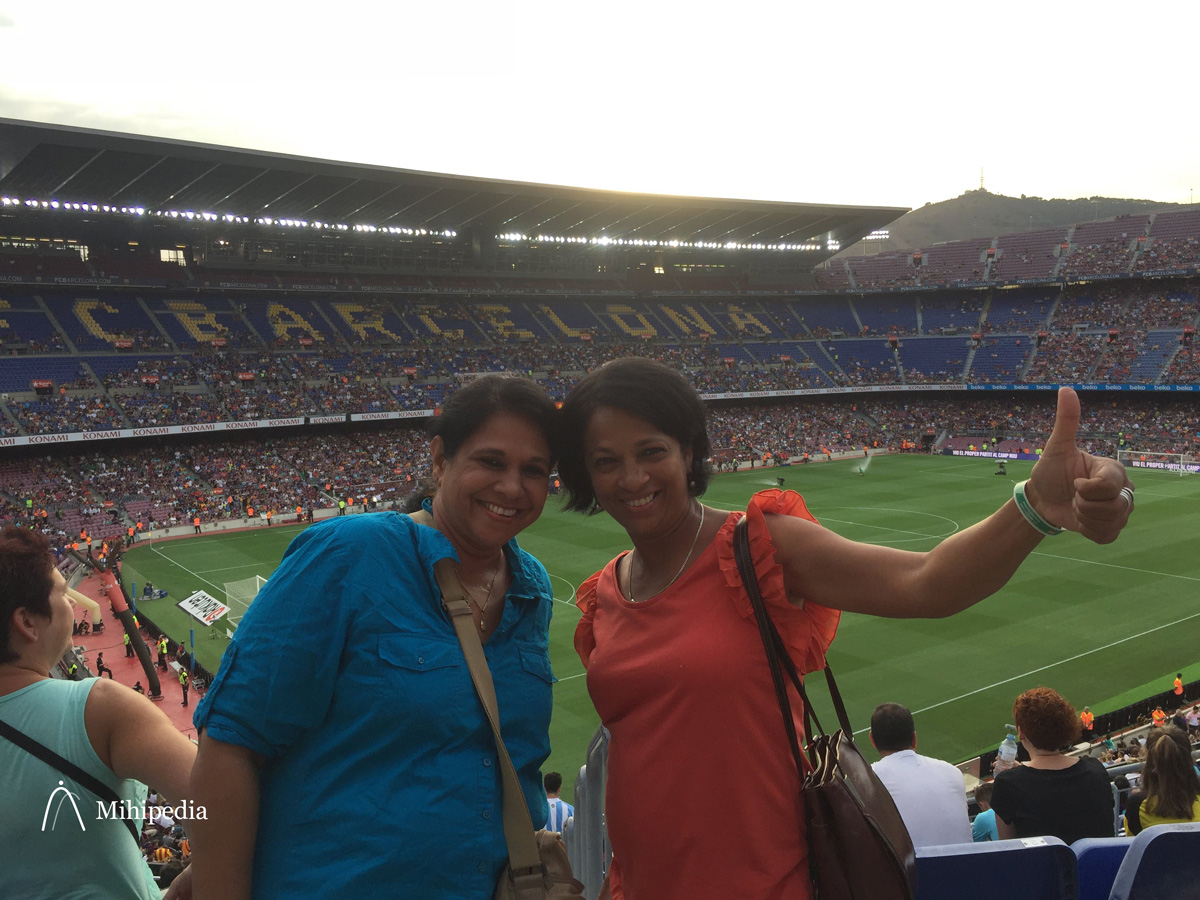
One of the greatest pleasures of travelling is the kindness of friends, and on this occasion I owe a huge thank you to my dear friend Jan Tissera. Knowing I was in Barcelona, Jan somehow managed to get me tickets to that evening’s Joan Gamper Trophy at the legendary Camp Nou. Watching FC Barcelona play at their home stadium was already a dream come true, but this was no ordinary football match.
The annual Joan Gamper Trophy traditionally marks the start of Barcelona’s new season, but in 2017 the occasion carried far deeper significance. Barcelona had invited the Brazilian club Chapecoense, whose football team had suffered one of the greatest tragedies in sporting history. In November 2016, LaMia Flight 2933 crashed in Colombia while carrying the team to the Copa Sudamericana Final, claiming the lives of most of the players, coaching staff and officials. The disaster united the football world in grief, and Barcelona’s invitation was intended as a gesture of solidarity and respect.
As I entered Camp Nou, the atmosphere was unlike anything I had experienced before. There was excitement, naturally, because watching Barcelona play at one of football’s most iconic stadiums is special in itself. But there was also a sense that this evening was about much more than football.


Before kick-off, the surviving members of the Chapecoense tragedy walked onto the pitch to a standing ovation. Goalkeeper Jakson Follmann, who had lost part of his right leg in the crash, and defender Neto took part in the ceremonial kick-off, while captain Alan Ruschel remarkably returned to competitive football after surviving injuries that could easily have ended both his life and career. When Ruschel was substituted after thirty-five minutes, the entire stadium rose as one to applaud him. It was an incredibly emotional moment and a reminder that sport has the power to unite people in ways that few other things can.
Then came the football.
Watching Lionel Messi play live was something I had always hoped to experience. Alongside stars such as Luis Suárez, Andrés Iniesta, Sergio Busquets and Gerard Piqué, Barcelona played with a confidence and fluency that television simply cannot capture. What struck me most about Messi was not just his skill on the ball but his movement without it. Even when he wasn’t in possession, every eye in the stadium seemed to follow him. And we were sitting in “Messi’s Corner!” There was an expectation every time he received the ball that something extraordinary might happen.
And, true to form, it did.
Messi scored as Barcelona went on to defeat Chapecoense 5-0, but strangely the scoreline felt almost secondary. As supporters left the stadium, conversations centred less on the goals and more on the remarkable courage of the Chapecoense players who had returned to the pitch after unimaginable tragedy. It was one of those rare occasions when football became a celebration of resilience, hope and humanity rather than simply a contest between two teams.
Leaving Camp Nou that evening, I realised I had experienced something truly special. Thanks to Jan’s generosity, I hadn’t simply watched one of the world’s greatest footballers in action. I had witnessed an unforgettable evening that demonstrated the power of sport to heal, inspire and bring people together.

The following morning it was time to leave Barcelona. One last walk along La Rambla, one final treat and a lingering look at the city that had so effortlessly captured my imagination before making my way to the airport. A Vueling Airlines flight took me back to Amsterdam, where I would connect with my flight home, bringing another unforgettable European adventure to an end.
Barcelona had exceeded every expectation. In just two days it had introduced me to Gaudí’s architectural genius, the flavours and colours of La Boqueria, the infectious atmosphere of La Rambla and one of the most memorable sporting experiences of my life. It is a city that celebrates creativity, embraces history and wears its passion proudly on its sleeve.
As my aircraft climbed above the Catalan coastline, I looked down one last time and smiled. Barcelona had been far more than another stop on my itinerary. It had been an experience filled with colour, culture, friendship and unforgettable memories. Some journeys stay with you because of the places you visit. Others stay with you because of the moments you never expected. Barcelona gave me both.