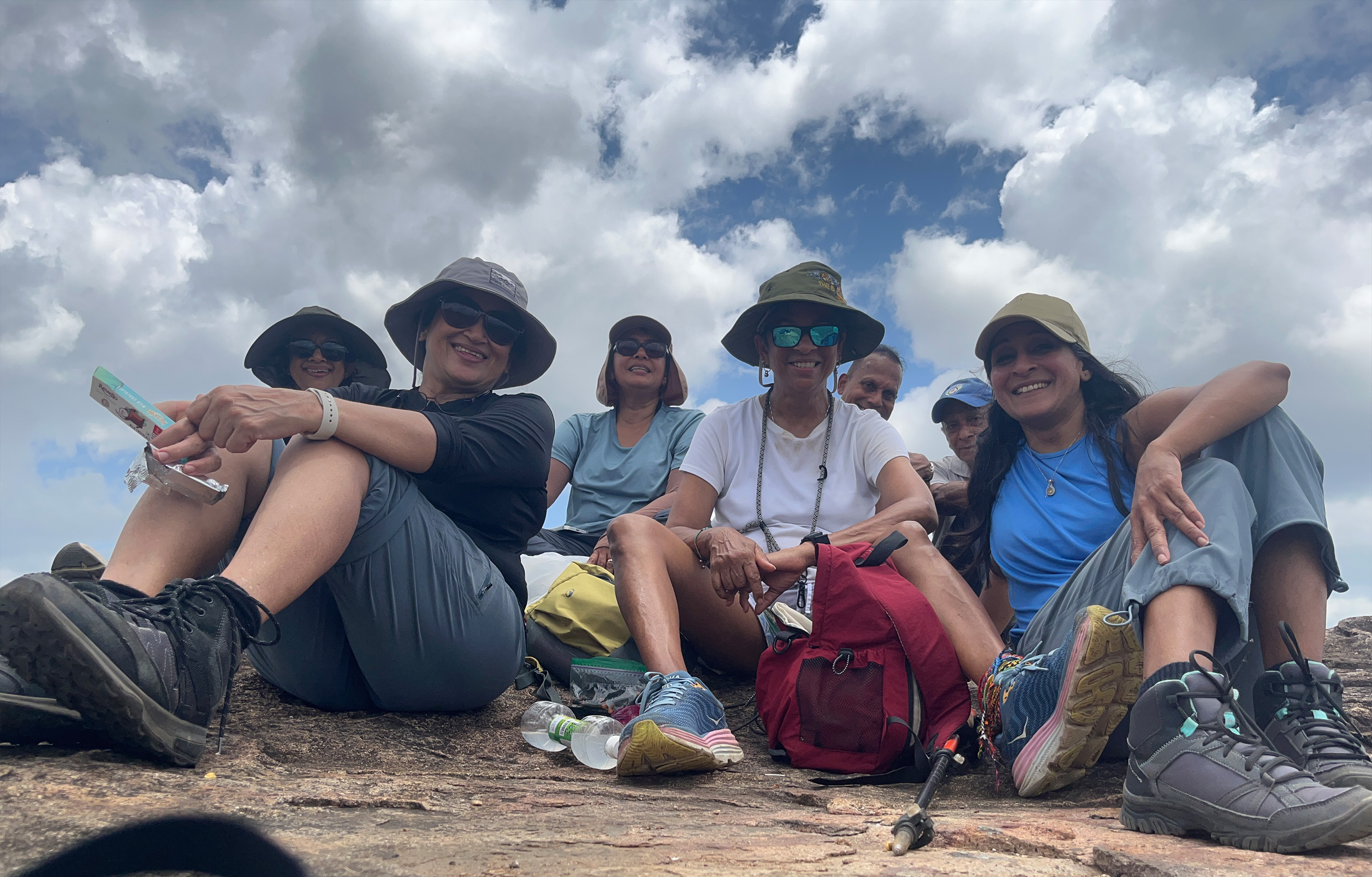
Leaving Colombo behind on this balmy Saturday morning, we wound our way through the lush countryside towards Atamba Ella, a beautiful and peaceful waterfall hidden in Sri Lanka’s Kalutara District. Nestled in the quiet village of Udugalakanda, near Bulathsinhala, Atamba Ella is one of those secret spots that still feels wonderfully untouched.


The waterfall itself isn’t towering or dramatic. Instead, its charm lies in its serenity. Crystal-clear water tumbles gently over smooth rock into emerald pools, shaded by dense forest and accompanied only by birdsong and the soothing sound of flowing water.
It didn’t take much convincing before we were in.
There is something magical about bathing in a natural river. No chlorine. No crowds. Just refreshingly cold mountain water washing away the week’s stress while tiny fish dart around your feet. It was impossible not to linger longer than planned.
Eventually, we dried off and headed towards what would become the historical highlight of the day.

Rising high above the surrounding landscape is Pahiyangala Rock Cave, one of Sri Lanka’s most remarkable archaeological sites and among the largest natural rock caves in Asia.
The climb? Surprisingly easy.


From the entrance, it’s only about 200 metres uphill, taking us roughly 20 minutes at a leisurely pace. The path is well laid out and manageable for anyone with a reasonable level of fitness, making the reward at the top even sweeter.
And what a reward it was.

At the top, beside the enormous cave, stands a 13-metre-long reclining Buddha, said to be more than a century old. Its peaceful presence seems almost dwarfed by the vast rock overhang behind it.


There is also a fascinating local legend connected to the temple. A monk named Porogama Thero is said to have cleared the cave, which had become engulfed in thick jungle, in order to establish a temple here. At the foot of the reclining Buddha lies Yakula, the enormous iron chisel he is believed to have used.
Measuring almost two meters in length, Yakula is an extraordinary object in itself. The iron is so heavy that the monk’s alleged ability to wield it is regarded locally as something of a miracle. Standing beside it, I could certainly understand why the story has survived through generations.
Waiting for us was Chaminda, the cave’s caretaker, who enthusiastically shared the history and legends of Pahiyangala. Listening to his stories while standing beneath the enormous rock overhang brought the place to life in a way that no information board ever could.

The cave is named after the Chinese Buddhist monk Faxian (Fa-Hien), who is believed to have stayed here during his travels across Sri Lanka in the 5th century AD. Local tradition also holds that as many as 3,500 Buddhist monks once lived within this vast cave, using its immense natural shelter as a monastery. Standing beneath the colossal granite ceiling, it suddenly doesn’t seem impossible. The cave is enormous—large enough to house an entire village beneath its rocky canopy.
Long before monks arrived, however, this cave was already home to Sri Lanka’s earliest inhabitants.


Archaeologists have uncovered evidence of prehistoric humans living here nearly 48,000 years ago. Stone tools, animal remains and human skeletons discovered during excavations have made Pahiyangala one of the most significant prehistoric sites in South Asia, offering remarkable insights into the lives of the island’s earliest hunter-gatherers.

Having previously visited Batadomba Lena, another of Sri Lanka’s famous prehistoric caves, I couldn’t help but compare the two. Both are part of the same ancient quartzite rock formations that dominate this region and have yielded extraordinary archaeological discoveries. Batadomba Lena feels intimate and tucked away in the forest, while Pahiyangala is its much grander sibling—a monumental natural cathedral that leaves you feeling wonderfully insignificant beneath its towering ceiling.
It’s fascinating that two caves, relatively close to each other, have helped rewrite so much of Sri Lanka’s prehistoric story.
The site is currently undergoing renovations, with new access being constructed to reach the very top of the rock. According to Chaminda, visitors should be able to enjoy the summit in about five months’ time, adding yet another reason to return.
After a morning of river dips and prehistoric discoveries, our stomachs began reminding us that history is best appreciated on a full belly.
As always, Sri Lanka delivered.


A tiny roadside kade appeared at just the right moment, serving exactly the kind of lunch every road trip deserves. Plates of steaming rice, homemade curries, freshly cooked vegetables, spicy sambols and crispy papadams arrived without any fuss. There were no fancy menus or stylish interiors—just genuine village hospitality and food that tasted like it had come straight from someone’s family kitchen.
Sometimes, that’s all you really need. With satisfied appetites and cameras full of memories, we pointed the car back towards Colombo.
In a single day we’d cooled off beneath one of Kalutara’s hidden waterfalls, walked through nearly 50,000 years of human history, listened to stories from a passionate local caretaker, and finished it all with a simple roadside feast.
That’s the beauty of travelling in Sri Lanka. You never have to go very far to find an adventure. Sometimes, the perfect Saturday is waiting just a couple of hours from home.