I have learnt that the success of any hike depends on three things: a good breakfast, a decent pair of shoes and a healthy degree of misplaced confidence. We had all three when we set off for Yakdessagala.
For this Mihipedia Getaway weekend, our day began at 5.00 a.m. in Colombo, and a couple of hours later, we pulled into Amakie in Kurunegala for breakfast, and quite frankly, the mountain could wait. We had breakfast to attend to.
We are a group that takes adventure seriously, but we take food even more seriously.
With full stomachs, cheerful faces and absolutely no idea what the mountain had in store for us, we continued for another 20 minutes towards Yakdessagala.

By about 9.15 a.m., we had reached the temple grounds at the foot of the mountain. We checked our water and snacks, adjusted our backpacks, made sure our shoes were properly tied and, at around 9.30 a.m., finally started walking.

At approximately 540 metres above sea level, Yakdessagala rises dramatically from the dry-zone landscape of Kurunegala. Also known as Kuvenigala, it is a rugged mass of rock, forest and boulders, with a reputation for being considerably tougher than its height might suggest. The trail winds through dry forest and thorny scrub before becoming increasingly rocky and steep, with large boulders and exposed sections demanding rather more from the legs than we had perhaps anticipated.
The mountain also comes with a rather dramatic backstory. Yakdessagala is associated with the legend of Kuveni, the Yaksha queen from the story of King Vijaya. According to traditional accounts, after Vijaya abandoned her, Kuveni returned to her own people but was rejected by them too. She is said to have climbed this rock, cursed Vijaya and his descendants and eventually thrown herself from the mountain. Whether you take the story as history, legend or something in between, it certainly adds atmosphere. There is something rather dramatic about climbing a mountain while thinking that, according to local tradition, a heartbroken queen once stood somewhere up there contemplating the fate of an entire kingdom. Personally, I was more concerned with the fate of my knees.


Because the climb gets serious almost immediately. There is no gentle warm-up where the mountain gives you a chance to settle into a comfortable rhythm. It goes up, and then it goes up some more. Before long, we were scrambling over boulders, hauling ourselves up rocky sections and grabbing tree roots whenever they offered something resembling a handhold.


Some sections felt almost vertical, and the combination of steep rock, heat and constant climbing had us sweating very quickly.


The forest was a blessing because it provided shade for much of the ascent, but it also made the trail less obvious. This is not a neatly marked tourist trail with broad steps and signboards telling you how far you have come.


The route is marked in places with arrows and crosses painted on rocks and little pieces of thread tied to trees. They are easy enough to miss when you are concentrating on where to put your next foot. We noticed some. Clearly, we did not notice all of them.


We settled into the familiar rhythm of any difficult hike. Climb for a while, stop for water, have some isotonic, eat something, complain about the heat, check on each others knees and feet and then continue as though none of us had learnt anything from the previous ten minutes.

Every now and then the trees opened up and we caught a glimpse of the countryside below. Those views were always welcome, partly because they were beautiful and partly because they provided an excellent excuse to stop climbing and take photographs.
The higher we climbed, the more spectacular the landscape became. The flat plains, forests, villages and distant rocky hills gradually spread out beneath us, and the effort suddenly seemed worthwhile. There is something very satisfying about watching the landscape get smaller as you climb. It is also useful photographic evidence when people later ask whether you really hiked all the way up there.


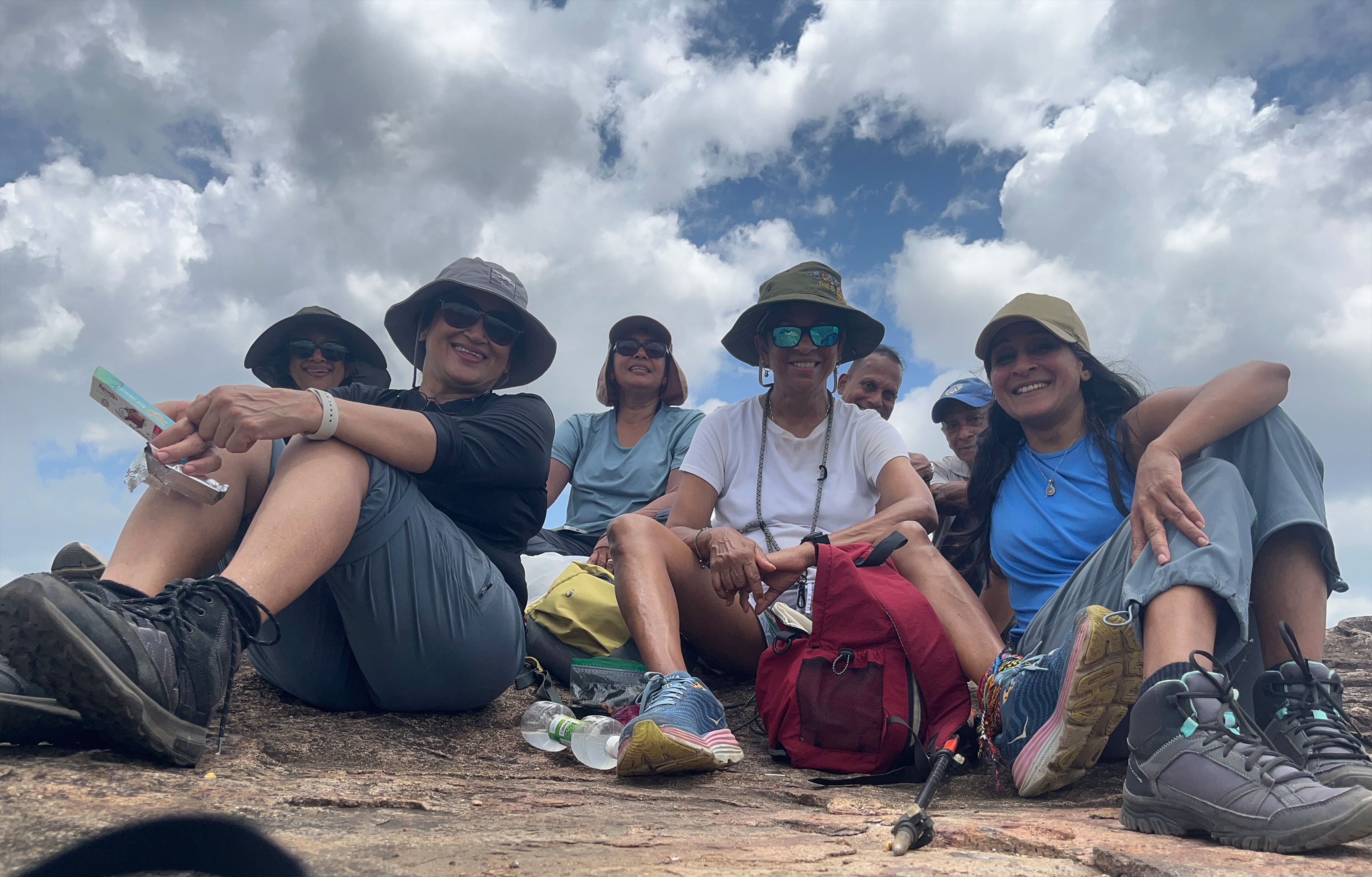
By around 12 noon, we finally reached the summit. And yes, it was worth every sweaty, exhausting step. From the top, the Kurunegala landscape stretches out in a vast patchwork of green vegetation, cultivated land, villages, roads and isolated rocky hills. We found a place to sit, drank plenty of water, ate our snacks and simply enjoyed the view. Nobody seemed particularly keen to move. After the climb we had just endured, we felt we had earned the right to sit there for a while.
Eventually, however, gravity and common sense reminded us that we had to come down. We assumed the descent would be easier. It wasn’t. Somewhere along the way, we missed the trail, and those discreet little arrows and crosses that had seemed adequate on the way up suddenly became impossible to find. Neither could we see the little pieces of thread tied to the trees.


There is a particular moment when you are hiking and someone says, “I think we should go this way,” and everyone looks at each other because nobody actually knows. That was more or less where we found ourselves. We retraced our steps, searched around for the markings and eventually managed to locate a path that led us down. It was a useful reminder that those rather unimpressive little marks on rocks are actually quite important.

By around 2.30 p.m., we finally made it back to the bottom. Five hours on the mountain had left us hot, sweaty, dusty and more than ready for the next important stage of the day’s adventure: getting wet.
Fortunately, we had the Deduru Oya.


Back at the hotel, we took a dip in the rather muddy waters of the river. I say “dip” because it sounds much more elegant than what actually happened. After several hours of climbing through a hot, dry forest, nobody was particularly concerned about whether the water was crystal clear. Muddy or not, it was wonderfully refreshing, and there was something deeply satisfying about washing away the sweat and dust of the mountain.

That evening was exactly what a good hiking trip should end with: dinner, drinks and a lot of laughter. Prad had promised special cocktails, and he delivered, while the day’s events were already becoming funnier now that we were safely off the mountain. Getting lost is rarely amusing while you are actually lost. Once you are back at the hotel, showered, fed and holding a drink, it becomes an excellent story.
The company made the adventure even better. Prad, our newbie, joined Mihipedia veterans Hemanthi, Anoma, Anna, Ranji bappa (RB) and Ruvinika, and somehow this slightly unlikely collection of people became a very good hiking team. That is one of the things I enjoy most about these Mihipedia adventures. You start the day as a group of people who may or may not know each other particularly well, and somewhere between the sweating, complaining, helping each other over rocks and sharing snacks, you become a team.

I have give a special mention to my maternal uncle RB, who at age 86 is proof that adventure has no age limit. Every time he joins one of these hikes, I am reminded that adventure really does not have an expiry date. While the rest of us were worrying about the steep rocks, tired legs, heat and whether we were still on the correct trail, RB simply kept going. Watching him is a pretty good reminder that age is really only a number until you decide to make it an excuse.

By Sunday, we were on our way back to Colombo, home in time for lunch. The mountain was behind us, our clothes had acquired a generous coating of dust and our legs were probably wondering why we continue to do these things to them. But that is the funny thing about hiking. While you are doing it, you sweat, struggle, question your decisions and occasionally wonder why you didn’t choose a nice air-conditioned restaurant instead. Then you finish, sit around with your friends, laugh about the difficult bits and start talking about where you should go next.
Yakdessagala gave us a bit of everything I love about these adventures: history, legend, dense forest, crazy rocks, a seriously tough climb, spectacular views, sweat, a wrong turn, muddy river water, good food and even better company. It was tiring, challenging and at times brutally hard, but it was also enormous fun.
Not a bad way to spend a Saturday. And yes, I would probably do it again.


It was s another successful adventure organized by you Mihiri.
After weeks have passed my knees are still complaining lol.
Thanks for another enjoyable hike & weekend.
It’s always fun and fabulous when we all hike together. We make such a great team. Your knees will recover…eventually 🙂